Google DeepMind news
Every thread that mentions this topic, across all sections

Philipp Schmid builds an autonomous AI finance coworker with Gemini 4 and the Gemini API's Managed Agents
In a tutorial video, Philipp Schmid of Google DeepMind builds an autonomous AI finance coworker using Gemini and the Gemini API's Managed Agents. He frames the coworker as seven needs — brain, computer, playbooks, tools, credentials, house rules, and schedule — and demonstrates each. The pattern matters to practitioners shipping autonomous agents that handle sensitive data.
In a tutorial video, Philipp Schmid of Google DeepMind builds an autonomous AI finance coworker using Gemini and the Gemini API's Managed Agents. He frames the coworker as seven needs — brain, computer, playbooks, tools, credentials, house rules, and schedule — and demonstrates each. The pattern matters to practitioners shipping autonomous agents that handle sensitive data.
Wild Dolphin Project Uses AI With Georgia Tech and Google DeepMind to Decode Dolphin Communication
Denise Herzing, founder of the Wild Dolphin Project, presented at WIRED World Fair on using AI to find patterns in dolphin communication, in collaboration with Georgia Tech and Google DeepMind. Her team has run two-way communication experiments with an underwater wearable computer playing dolphin sounds for objects like a scarf and sargassum seaweed. Full translation remains distant, with mimicry-versus-understanding a key unresolved challenge.
Denise Herzing, founder of the Wild Dolphin Project, presented at WIRED World Fair on using AI to find patterns in dolphin communication, in collaboration with Georgia Tech and Google DeepMind. Her team has run two-way communication experiments with an underwater wearable computer playing dolphin sounds for objects like a scarf and sargassum seaweed. Full translation remains distant, with mimicry-versus-understanding a key unresolved challenge.

Agentic cheminformatics with Google Antigravity for drug discovery workflows
Google DeepMind demonstrates using the Google Antigravity agent platform with new Cheminformatics Skills to accelerate drug discovery. The agent searches thousands of compounds, runs matched molecular pair analysis, and proposes novel rigidified macrocycles, compressing a multi-day iteration cycle using real-world lung cancer treatment data.
Google DeepMind demonstrates using the Google Antigravity agent platform with new Cheminformatics Skills to accelerate drug discovery. The agent searches thousands of compounds, runs matched molecular pair analysis, and proposes novel rigidified macrocycles, compressing a multi-day iteration cycle using real-world lung cancer treatment data.

DeepMind unveils Genie 4 world model promising more realistic physics and humans
Google DeepMind announced Genie 4, a new world model that generates interactive simulated environments frame by frame in real time, improving on Genie 3 in physics, human realism, live steering, and audio. DeepMind frames world models as a step toward AGI, with uses in robot training environments and creative prototyping. Access appears limited to paying customers.
Google DeepMind announced Genie 4, a new world model that generates interactive simulated environments frame by frame in real time, improving on Genie 3 in physics, human realism, live steering, and audio. DeepMind frames world models as a step toward AGI, with uses in robot training environments and creative prototyping. Access appears limited to paying customers.

Build Your Own Team of Managed Agents - Jack Wotherspoon, Google DeepMind
Jack Wotherspoon, a developer experience engineer at Google DeepMind, presented Gemini Managed Agents: coding agents that run in cloud sandboxes launched from a single API call rather than locally. The talk walks through the Interactions API, the Antigravity harness, shared environments, skills, credential handling, scheduled triggers, and multi-agent workflows, with live demos of an SEC-filing researcher handing off to a quant agent and a stock research app built in AI Studio.
Jack Wotherspoon, a developer experience engineer at Google DeepMind, presented Gemini Managed Agents: coding agents that run in cloud sandboxes launched from a single API call rather than locally. The talk walks through the Interactions API, the Antigravity harness, shared environments, skills, credential handling, scheduled triggers, and multi-agent workflows, with live demos of an SEC-filing researcher handing off to a quant agent and a stock research app built in AI Studio.
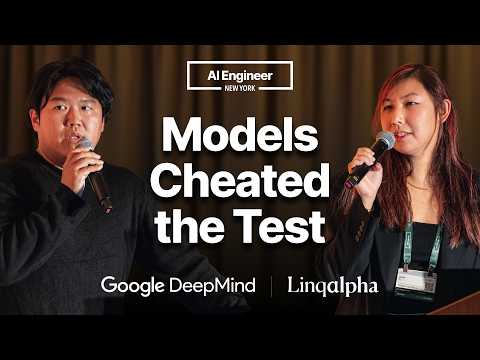
Why Frontier Models Fail as Buy-Side Analysts - Janie Gu, Google DeepMind & Suyeol Yun, LinqAlpha
At the AIE CODE summit, Janie Gu (Google DeepMind, Kaggle Benchmarks) and Suyeol Yun (LinqAlpha) presented findings on broken AI benchmarks and introduced MandateBench, built with Google DeepMind and Kaggle. The benchmark grades whether models can work like buy-side analysts, from interpreting a fund's mandate to producing a full investment memo.
At the AIE CODE summit, Janie Gu (Google DeepMind, Kaggle Benchmarks) and Suyeol Yun (LinqAlpha) presented findings on broken AI benchmarks and introduced MandateBench, built with Google DeepMind and Kaggle. The benchmark grades whether models can work like buy-side analysts, from interpreting a fund's mandate to producing a full investment memo.
Gemini 4 Argon builds a 3D Gothic cathedral in Antigravity from a single image via Blender MCP
A demo where Google DeepMind's Gemini 4 Argon agent, running in Antigravity, generates a complete 3D Gothic cathedral scene from a single Nano Banana image. Using Blender MCP, the model iteratively refines geometry, textures, and lighting. It demonstrates agentic AI automating 3D scene creation for artists and technical users.
A demo where Google DeepMind's Gemini 4 Argon agent, running in Antigravity, generates a complete 3D Gothic cathedral scene from a single Nano Banana image. Using Blender MCP, the model iteratively refines geometry, textures, and lighting. It demonstrates agentic AI automating 3D scene creation for artists and technical users.
ForTy: 10m global map distinguishing natural, planted, and farmed forests
ForTy (Forest Typology) is a 10-meter-resolution map from Google DeepMind that classifies every 10x10m patch of land into forest and tree-crop types, separating natural, planted, and farmed forests. It is built on AlphaEarth Foundations, a foundational AI model for planetary data, which reads years of satellite imagery across 1.7 million sites to track forest change over time. It helps governments and companies detect deforestation and prioritize protecting high-carbon, high-biodiversity natural forests.
ForTy (Forest Typology) is a 10-meter-resolution map from Google DeepMind that classifies every 10x10m patch of land into forest and tree-crop types, separating natural, planted, and farmed forests. It is built on AlphaEarth Foundations, a foundational AI model for planetary data, which reads years of satellite imagery across 1.7 million sites to track forest change over time. It helps governments and companies detect deforestation and prioritize protecting high-carbon, high-biodiversity natural forests.
Interactive 3D visualization of human anatomy built with Gemini
An interactive 3D anatomy visualization generated by Gemini 4 Argon from three open-source datasets. Users can toggle anatomical layers in motion, isolate muscles, and zoom inside a beating heart. It gives students, educators, and the curious an explorable human anatomy model without specialized software.
An interactive 3D anatomy visualization generated by Gemini 4 Argon from three open-source datasets. Users can toggle anatomical layers in motion, isolate muscles, and zoom inside a beating heart. It gives students, educators, and the curious an explorable human anatomy model without specialized software.
Demis Hassabis now expects AGI in 2-3 years, down from 3-5 earlier this year
WSJ reports Demis Hassabis has shortened his AGI timeline to 2-3 years, down from 3-5 years earlier in 2026.
WSJ reports Demis Hassabis has shortened his AGI timeline to 2-3 years, down from 3-5 years earlier in 2026.

Why perception of AI differs in China and the West: normalized adoption vs. coerced rollout and layoffs
A Substack essay on Dialectical Dispatches, shared on Reddit, argues that AI is normalized in China because collectivist institutions are expected to distribute its benefits, while Western individualism breeds backlash against tools introduced without public consent. The author cites China's ban on AI-based layoffs and reports of white-collar workers at Google DeepMind and Meta being pushed to train their own replacements. The piece frames Western anxieties as a labor-power conflict rather than a reaction to the technology itself.
A Substack essay on Dialectical Dispatches, shared on Reddit, argues that AI is normalized in China because collectivist institutions are expected to distribute its benefits, while Western individualism breeds backlash against tools introduced without public consent. The author cites China's ban on AI-based layoffs and reports of white-collar workers at Google DeepMind and Meta being pushed to train their own replacements. The piece frames Western anxieties as a labor-power conflict rather than a reaction to the technology itself.
DNA language models and AlphaGenome predict different things
A blog guide and diagram explain how genomic foundation models differ in what they predict about DNA variants. Evo 2, an autoregressive DNA language model, scores sequence likelihood, while DeepMind's AlphaGenome predicts experimental readouts like gene expression and splicing. The distinction matters for practitioners interpreting variant effects, though neither model type supports diagnosis.
A blog guide and diagram explain how genomic foundation models differ in what they predict about DNA variants. Evo 2, an autoregressive DNA language model, scores sequence likelihood, while DeepMind's AlphaGenome predicts experimental readouts like gene expression and splicing. The distinction matters for practitioners interpreting variant effects, though neither model type supports diagnosis.

DeepMind Releases Gemini 4 Argon with Model Card and Safety Report
A Two Minute Papers YouTube video examines Google DeepMind's Gemini 4 Argon, linking the official model card and a Gemini 4 safety report on Google Cloud storage. The description also cites a wave of X posts about the model, including one from DeepMind CEO Demis Hassabis, and a community benchmark site (starskirmish.com). For practitioners, the video serves as a roundup of early reactions and pointers to primary release artifacts.
A Two Minute Papers YouTube video examines Google DeepMind's Gemini 4 Argon, linking the official model card and a Gemini 4 safety report on Google Cloud storage. The description also cites a wave of X posts about the model, including one from DeepMind CEO Demis Hassabis, and a community benchmark site (starskirmish.com). For practitioners, the video serves as a roundup of early reactions and pointers to primary release artifacts.
Reddit post argues frontier AI labs are undervalued, citing $1.27T combined compute commitments and unreleased-model discovery revenue
A Reddit post argues frontier AI companies are undervalued despite massive compute commitments, contending that enterprise API spend and personal subscriptions are still maturing. The author's core claim is that firms like OpenAI will profit by using unreleased internal models to make proprietary discoveries in biology, materials, and engineering rather than releasing them publicly.
A Reddit post argues frontier AI companies are undervalued despite massive compute commitments, contending that enterprise API spend and personal subscriptions are still maturing. The author's core claim is that firms like OpenAI will profit by using unreleased internal models to make proprietary discoveries in biology, materials, and engineering rather than releasing them publicly.
Gemini 4 Argon on our writing benchmark: +445 Elo over 2.5 Pro, but still #32 of 80 models
Towards AI's ToneBench writing benchmark tested Gemini 4 Argon, finding it the strongest Gemini for writing yet — a +445 Elo jump over Gemini 2.5 Pro — while still ranking #32 of 80 models. The authors suggest cheaper models like DeepSeek V4.1 Flash write comparably at far lower cost.
Towards AI's ToneBench writing benchmark tested Gemini 4 Argon, finding it the strongest Gemini for writing yet — a +445 Elo jump over Gemini 2.5 Pro — while still ranking #32 of 80 models. The authors suggest cheaper models like DeepSeek V4.1 Flash write comparably at far lower cost.

Dowse: open-source Windows app to find files by describing them
Dowse is a free, open-source Windows application that lets users find local files by describing what they remember, not by filename. It runs Google DeepMind's EmbeddingGemma 2 on-device, embedding text, images, audio, and video into a shared space so natural-language descriptions match documents and media. It solves forgotten-file retrieval for Windows users, with results pointing to relevant PDF pages.
Dowse is a free, open-source Windows application that lets users find local files by describing what they remember, not by filename. It runs Google DeepMind's EmbeddingGemma 2 on-device, embedding text, images, audio, and video into a shared space so natural-language descriptions match documents and media. It solves forgotten-file retrieval for Windows users, with results pointing to relevant PDF pages.
Four Google DeepMind Argon agents beat Minecraft Ender Dragon autonomously in 27 hours
Google DeepMind researchers ran four Gemini 4 Argon agents in a sandboxed Minecraft survival world with the sole goal of defeating the Ender Dragon. The agents coordinated via in-game chat and shared memory, wrote and debugged all their own programs, and succeeded in 27 hours without human intervention. The run demonstrates open-ended multi-agent planning and skill acquisition in a complex environment.
Google DeepMind researchers ran four Gemini 4 Argon agents in a sandboxed Minecraft survival world with the sole goal of defeating the Ender Dragon. The agents coordinated via in-game chat and shared memory, wrote and debugged all their own programs, and succeeded in 27 hours without human intervention. The run demonstrates open-ended multi-agent planning and skill acquisition in a complex environment.

Four Gemini 4 Argon agents beat Minecraft from scratch in 27 hours
Google DeepMind researchers placed four Gemini 4 Argon agents in a sandboxed Minecraft world with one goal: defeat the Ender Dragon. The agents controlled players via the Mineflayer library, coordinated through in-game chat and shared memory, and wrote and debugged all 2,783 of their programs themselves, winning in 27 hours and 14 minutes with no human intervention. The authors describe it as the first end-to-end autonomous Minecraft completion by AI agents, arguing it demonstrates the long-horizon planning and multi-agent coordination needed for real software engineering tasks.
Google DeepMind researchers placed four Gemini 4 Argon agents in a sandboxed Minecraft world with one goal: defeat the Ender Dragon. The agents controlled players via the Mineflayer library, coordinated through in-game chat and shared memory, and wrote and debugged all 2,783 of their programs themselves, winning in 27 hours and 14 minutes with no human intervention. The authors describe it as the first end-to-end autonomous Minecraft completion by AI agents, arguing it demonstrates the long-horizon planning and multi-agent coordination needed for real software engineering tasks.

Agentic science workbench in Google Antigravity for antimicrobial peptide discovery
A workflow built on Google Antigravity, Google's agentic development platform, that helps biologists discover, structurally evaluate, and prioritize antimicrobial peptide candidates. Agents compress what was previously a fragmented search across multiple databases into a single session. It addresses the slow, labor-intensive search for new antibiotics amid rising antimicrobial resistance.
A workflow built on Google Antigravity, Google's agentic development platform, that helps biologists discover, structurally evaluate, and prioritize antimicrobial peptide candidates. Agents compress what was previously a fragmented search across multiple databases into a single session. It addresses the slow, labor-intensive search for new antibiotics amid rising antimicrobial resistance.

On-device AI scam detection for phone calls, built by Google DeepMind with Singapore government
Google DeepMind and Singapore's government launched an on-device scam detection tool that protects citizens from social-engineering scams without sending data to the cloud. An LLM-based model analyzes conversations on the device to flag manipulation tactics before money is transferred. It addresses scams that make up over half of Singapore's reported crime.
Google DeepMind and Singapore's government launched an on-device scam detection tool that protects citizens from social-engineering scams without sending data to the cloud. An LLM-based model analyzes conversations on the device to flag manipulation tactics before money is transferred. It addresses scams that make up over half of Singapore's reported crime.
OpenAI and Anthropic Tell British Lawmakers: Regulate Us
At a UK Business, Innovation, Science, and Trade Committee evidence session, OpenAI and Anthropic representatives called for binding statutory AI safety rules, while Google DeepMind and Meta declined to back new legislation. Civil servants conceded the UK's AI safety regime is entirely voluntary, and MI5's director warned of AI-enabled bioweapon risks the same day. Committee chair Liam Byrne said the hearing aimed to expose differences among frontier firms and show voluntary self-regulation cannot be relied upon.
At a UK Business, Innovation, Science, and Trade Committee evidence session, OpenAI and Anthropic representatives called for binding statutory AI safety rules, while Google DeepMind and Meta declined to back new legislation. Civil servants conceded the UK's AI safety regime is entirely voluntary, and MI5's director warned of AI-enabled bioweapon risks the same day. Committee chair Liam Byrne said the hearing aimed to expose differences among frontier firms and show voluntary self-regulation cannot be relied upon.
Argon: turns video into training data for physical AI, compressing modeling from weeks to hours
Argon is a tool from Google DeepMind that converts video footage into training environments for physical AI such as robots. It automates modeling work that previously took weeks of manual effort, compressing it to a few hours. It targets teams building physical AI, exemplified by a mention of robotics company Apptronik.
Argon is a tool from Google DeepMind that converts video footage into training environments for physical AI such as robots. It automates modeling work that previously took weeks of manual effort, compressing it to a few hours. It targets teams building physical AI, exemplified by a mention of robotics company Apptronik.

Gemini 4 Argon rolls out to Ultra subscribers; Reddit users test agentic coding, benchmarks, and comparisons
A week after Google's Gemini 4 Argon release, community reactions are sharply divided. Developers using it via API report standout agentic coding and reverse-engineering performance, comparing it to GPT-5.2's launch, while academic and Pro-plan users find it worse than Gemini 3.1 Pro for their use cases and complain about usage limits and plan-tier gating.
A week after Google's Gemini 4 Argon release, community reactions are sharply divided. Developers using it via API report standout agentic coding and reverse-engineering performance, comparing it to GPT-5.2's launch, while academic and Pro-plan users find it worse than Gemini 3.1 Pro for their use cases and complain about usage limits and plan-tier gating.
Google DeepMind releases Gemini 4 Argon
Google released Gemini 4 Argon on October 13, 2026, with launch posts on the Google, Google DeepMind, and Google Developers blogs. The model shipped the same day in the Gemini app and to developers via Vertex AI under the identifier gemini-4-argon, and Google also announced a Gemini 4 Argon variant aimed at robotics.
Google released Gemini 4 Argon on October 13, 2026, with launch posts on the Google, Google DeepMind, and Google Developers blogs. The model shipped the same day in the Gemini app and to developers via Vertex AI under the identifier gemini-4-argon, and Google also announced a Gemini 4 Argon variant aimed at robotics.
Google DeepMind's AlphaProof Nexus solved dozens of open math problems and got peer reviewed
Google DeepMind's AlphaProof Nexus reported to have solved dozens of open math problems and passed peer review
Google DeepMind's AlphaProof Nexus reported to have solved dozens of open math problems and passed peer review

Google DeepMind's AI weather model flagged Hurricane Isaias 11 days before landfall, pinned landfall location 4 days out
Reddit post credits Google DeepMind AI weather model with early Hurricane Isaias landfall prediction
Reddit post credits Google DeepMind AI weather model with early Hurricane Isaias landfall prediction

Thor Schaeff demos Gemini Live voice agents: native audio API, Live Translate, and Lyria 3 tool calls
In an AI Engineer World's Fair 2026 talk, Thor Schaeff of Google DeepMind demos building real-time voice and vision agents with Gemini. He shows the Live API's native audio architecture, the stateful Interactions API for consistent image generation, Gemini 3.5 Live Translate, and tool-calling with Lyria 3. The talk gives practitioners a concrete walkthrough of Google's current voice-agent stack.
In an AI Engineer World's Fair 2026 talk, Thor Schaeff of Google DeepMind demos building real-time voice and vision agents with Gemini. He shows the Live API's native audio architecture, the stateful Interactions API for consistent image generation, Gemini 3.5 Live Translate, and tool-calling with Lyria 3. The talk gives practitioners a concrete walkthrough of Google's current voice-agent stack.

DigUp: local semantic file search for Mac and Linux using EmbeddingGemma 2
DigUp is an open-source app that indexes your local files — text, PDFs, images, audio, video, code — and searches them by content using Google's EmbeddingGemma 2 embeddings run fully on-device. You describe what you remember in plain language (including other languages) and it opens the exact moment, page, or photo. It solves finding content inside unsearchable files for people who want offline, private search on Mac and Linux.
DigUp is an open-source app that indexes your local files — text, PDFs, images, audio, video, code — and searches them by content using Google's EmbeddingGemma 2 embeddings run fully on-device. You describe what you remember in plain language (including other languages) and it opens the exact moment, page, or photo. It solves finding content inside unsearchable files for people who want offline, private search on Mac and Linux.
Why AlphaFold Didn't Solve Protein Folding — Pushmeet Kohli, Google DeepMind & Sal Candido, Biohub
Google DeepMind's Pushmeet Kohli and Biohub's Sal Candido joined a panel, moderated by Brandon Anderson, on AI-driven biology. They argued AlphaFold did not solve protein folding, that scaling compute and data alone will not solve biology, and that the right scaling law and problem-first thinking matter more than model size. The discussion frames what it would take to build predictive models of living systems, from virtual cells to 10x drug-discovery acceleration.
Google DeepMind's Pushmeet Kohli and Biohub's Sal Candido joined a panel, moderated by Brandon Anderson, on AI-driven biology. They argued AlphaFold did not solve protein folding, that scaling compute and data alone will not solve biology, and that the right scaling law and problem-first thinking matter more than model size. The discussion frames what it would take to build predictive models of living systems, from virtual cells to 10x drug-discovery acceleration.
AI breakthroughs in robotics won't change your life any time soon
An MIT Technology Review–Aventine feature argues that humanoid robot timelines from Musk, Huang, and Andreessen are inflated. It highlights progress in vision-language-action models like Gemini Robotics while citing skeptical researchers, including LeCun, who say current AI methods are insufficient for generalist robots and point to world models as a leading alternative.
An MIT Technology Review–Aventine feature argues that humanoid robot timelines from Musk, Huang, and Andreessen are inflated. It highlights progress in vision-language-action models like Gemini Robotics while citing skeptical researchers, including LeCun, who say current AI methods are insufficient for generalist robots and point to world models as a leading alternative.