Artificial Analysis news
Every thread that mentions this topic, across all sections

Thinking Machines Lab releases Inkling 2 Small, highest-scoring non-Chinese open-weights model pending weights release
Thinking Machines Lab, the startup founded by ex-OpenAI CTO Mira Murati, announced Inkling 2 Small, a 594B-parameter Mixture-of-Experts model with image input support. It scores 31 on the Artificial Analysis Intelligence Index, tied with Gemini 3.8 Flash, and would become the highest-scoring open-weights model developed outside China once weights ship. Weights are held back for safety testing and red-teaming, with an Apache 2.0 release planned the following week.
Thinking Machines Lab, the startup founded by ex-OpenAI CTO Mira Murati, announced Inkling 2 Small, a 594B-parameter Mixture-of-Experts model with image input support. It scores 31 on the Artificial Analysis Intelligence Index, tied with Gemini 3.8 Flash, and would become the highest-scoring open-weights model developed outside China once weights ship. Weights are held back for safety testing and red-teaming, with an Apache 2.0 release planned the following week.
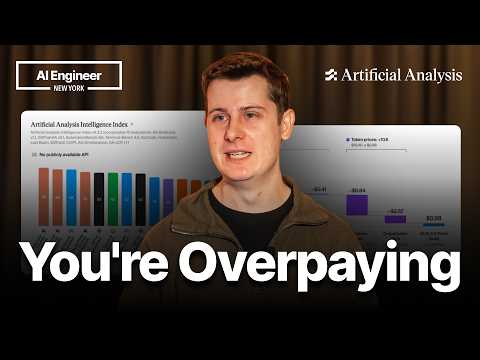
Without Caching, Your AI Agent Costs 10x More - George Cameron, Artificial Analysis
In a video walkthrough, Artificial Analysis co-founder George Cameron breaks down what drives AI agent costs in 2026: input tokens, cache hit rate, and step count. A worked example shows an agent task costing about $21 with caching versus over $200 without. He also frames when practitioners need the smartest model versus when a cheaper one produces the same answer.
In a video walkthrough, Artificial Analysis co-founder George Cameron breaks down what drives AI agent costs in 2026: input tokens, cache hit rate, and step count. A worked example shows an agent task costing about $21 with caching versus over $200 without. He also frames when practitioners need the smartest model versus when a cheaper one produces the same answer.
GPT-6.1 Terra (Max) Scores 48 on Artificial Analysis
GPT-6.1 Terra (Max) posts score of 48 on Artificial Analysis index
GPT-6.1 Terra (Max) posts score of 48 on Artificial Analysis index
Moonshot launches Kimi K3.1 Pro: 2.8T-param open-weight MoE model with 1M-token context
Moonshot AI launched Kimi K3.1 Pro, its most capable 3T-class open-weight model, alongside a Highspeed API variant claimed to be 2-3x faster at twice the price. Moonshot's benchmarks place it roughly level with Claude Opus 5.5 and GPT-6 Astra, and Artificial Analysis scored it at 55 — ahead of Claude Fable 5.1, GPT-6 Astra, and Gemini 4 Argon (all 53), behind only Opus 5.5 (58) — the highest score yet for an open-weight model. Pricing is $2/million input and $10/million output tokens, matching GPT-6.1 Sol and half the price of Opus 5.5.
Moonshot AI launched Kimi K3.1 Pro, its most capable 3T-class open-weight model, alongside a Highspeed API variant claimed to be 2-3x faster at twice the price. Moonshot's benchmarks place it roughly level with Claude Opus 5.5 and GPT-6 Astra, and Artificial Analysis scored it at 55 — ahead of Claude Fable 5.1, GPT-6 Astra, and Gemini 4 Argon (all 53), behind only Opus 5.5 (58) — the highest score yet for an open-weight model. Pricing is $2/million input and $10/million output tokens, matching GPT-6.1 Sol and half the price of Opus 5.5.

Baseten releases elephant-1 (9B, MIT, Qwen3.5-9B base), a decision model that ties d1-ultra on the AA Decision Index at about a quarter of the cost
Base Labs at Baseten released open weights for elephant-1, a 9B decision model post-trained from Qwen3.5-9B that outputs probabilities for classification-style questions instead of generating text. Artificial Analysis independently scored it 65 on the Decision Index, tying d1-ultra at roughly $8 per 1M tasks versus about $31. Intended uses include routing, guardrails, tool-call gating, and LLM-as-judge at volume.
Base Labs at Baseten released open weights for elephant-1, a 9B decision model post-trained from Qwen3.5-9B that outputs probabilities for classification-style questions instead of generating text. Artificial Analysis independently scored it 65 on the Decision Index, tying d1-ultra at roughly $8 per 1M tasks versus about $31. Intended uses include routing, guardrails, tool-call gating, and LLM-as-judge at volume.

Meta's 816B Muse Spark Open scores 39 on Artificial Analysis, the 180B Qwen3.8-Flash-Next scores 40. Score vs size for 11 open-weight models
A community-made chart plots Artificial Analysis index scores versus total parameters for 11 open-weight models, including Meta's new 816B Muse Spark Open and Qwen's 180B Qwen3.8-Flash-Next. It highlights how small active-parameter models match or beat far larger ones, with local-running memory requirements included.
A community-made chart plots Artificial Analysis index scores versus total parameters for 11 open-weight models, including Meta's new 816B Muse Spark Open and Qwen's 180B Qwen3.8-Flash-Next. It highlights how small active-parameter models match or beat far larger ones, with local-running memory requirements included.

Interactive chart of Artificial Analysis Intelligence Index vs model parameter count
A static interactive site plotting Artificial Analysis Intelligence Index scores against total and active parameter counts for LLMs, including MoE handling. It serves people choosing local models, since existing Artificial Analysis charts use price and speed axes instead of size. LLMs are the data being plotted, not the implementation.
A static interactive site plotting Artificial Analysis Intelligence Index scores against total and active parameter counts for LLMs, including MoE handling. It serves people choosing local models, since existing Artificial Analysis charts use price and speed axes instead of size. LLMs are the data being plotted, not the implementation.

DeepSeek-V4.1-Flash-1017 Terminal bench 4.0 score: model card reports 42.3%, AA 34%, Vals 31.82%
Community benchmarks of DeepSeek-V4.1-Flash-1017 on Terminal bench 4.0 fall short of the model card's reported number. A Reddit post comparing sources shows Artificial Analysis and Vals index scoring 34% and 31.82% versus the card's 42.3%.
Community benchmarks of DeepSeek-V4.1-Flash-1017 on Terminal bench 4.0 fall short of the model card's reported number. A Reddit post comparing sources shows Artificial Analysis and Vals index scoring 34% and 31.82% versus the card's 42.3%.

Wisedocs applies AI to messy insurance claims documents
A talk by Denys Linkov of Wisedocs explaining how AI processes unstructured insurance claim data — handwriting, faxes, duplicates, huge PDFs. It covers data cleaning, in-document analysis, cross-claim insights, and a medical records benchmark built with Artificial Analysis. The content addresses insurers struggling with unstructured claims documents.
A talk by Denys Linkov of Wisedocs explaining how AI processes unstructured insurance claim data — handwriting, faxes, duplicates, huge PDFs. It covers data cleaning, in-document analysis, cross-claim insights, and a medical records benchmark built with Artificial Analysis. The content addresses insurers struggling with unstructured claims documents.

DeepSeek V4.1 Flash 1017 checkpoint's token efficiency questioned; users lack a reliable benchmark
A Reddit user discusses the newly shipped DeepSeek V4.1 Flash 1017 checkpoint, complaining that only low-quality channels have covered it and that its celebrated cost efficiency comes from benchmarks they consider unreliable. They want a real token-efficiency benchmark and say the previous checkpoint was weak enough that GLM 5.3 Flash was the better option for them.
A Reddit user discusses the newly shipped DeepSeek V4.1 Flash 1017 checkpoint, complaining that only low-quality channels have covered it and that its celebrated cost efficiency comes from benchmarks they consider unreliable. They want a real token-efficiency benchmark and say the previous checkpoint was weak enough that GLM 5.3 Flash was the better option for them.

AA-AgentPerf: Artificial Analysis ranks NVIDIA Vera Rubin top on inference energy efficiency
Artificial Analysis's AA-AgentPerf benchmark replays real coding-agent trajectories — long contexts, tool-call pauses, heavy KV-cache reuse — to evaluate inference hardware. It plots total server throughput per megawatt of GPU-only power against p25 per-request output speed. Across the four tested models, NVIDIA's Vera Rubin sits at the frontier on energy efficiency at nearly every speed.
Artificial Analysis's AA-AgentPerf benchmark replays real coding-agent trajectories — long contexts, tool-call pauses, heavy KV-cache reuse — to evaluate inference hardware. It plots total server throughput per megawatt of GPU-only power against p25 per-request output speed. Across the four tested models, NVIDIA's Vera Rubin sits at the frontier on energy efficiency at nearly every speed.

InclusionAI open-sources 560B MoE Ling-3.1-flash under MIT with 210 tokens/s, AA Index 41, $0.19/M tokens
Ling-3.1-flash's weights are now available under an MIT license, adding a self-hostable option to the efficient-model space. The official release cites roughly 210 output tokens per second, an Artificial Analysis Intelligence Index around 41, and a blended price near $0.19 per million tokens.
Ling-3.1-flash's weights are now available under an MIT license, adding a self-hostable option to the efficient-model space. The official release cites roughly 210 output tokens per second, an Artificial Analysis Intelligence Index around 41, and a blended price near $0.19 per million tokens.

Artificial Analysis launches AA-Robotics v0.1 benchmark ranking LLMs on robotics tasks; GPT-6.1 Sol best overall
Artificial Analysis released AA-Robotics v0.1, a benchmark ranking LLMs on robotics tasks. Only a few models are scored so far; several complete most tasks but slowly, with GPT-6.1 Sol best overall when combining completion time and accuracy. Commenters see verifiable robotics tasks as a promising post-training path for scaling embodied AI.
Artificial Analysis released AA-Robotics v0.1, a benchmark ranking LLMs on robotics tasks. Only a few models are scored so far; several complete most tasks but slowly, with GPT-6.1 Sol best overall when combining completion time and accuracy. Commenters see verifiable robotics tasks as a promising post-training path for scaling embodied AI.

NVIDIA releases Nemotron-3.5-Super-VL-120B-A12B (MoE vision-language) on Hugging Face in base, NVFP4, and BF16
NVIDIA released the Nemotron 3.5 family as open weights: Super VL 120B-A12B, a multimodal model built for long-running agents, plus Bolt 74B-A9B (24GB) and Bolt E4B (4GB) edge models. ZDNET reports Super VL benchmarks 5x faster than the next best open agentic model per Artificial Analysis, with InclusionAI's Ling 3.0 Flash and DeepSeek's V4.1 Flash behind it. The releases land amid a Western surge in open-weight models from Mistral, Reflection AI, and others challenging Chinese labs.
NVIDIA released the Nemotron 3.5 family as open weights: Super VL 120B-A12B, a multimodal model built for long-running agents, plus Bolt 74B-A9B (24GB) and Bolt E4B (4GB) edge models. ZDNET reports Super VL benchmarks 5x faster than the next best open agentic model per Artificial Analysis, with InclusionAI's Ling 3.0 Flash and DeepSeek's V4.1 Flash behind it. The releases land amid a Western surge in open-weight models from Mistral, Reflection AI, and others challenging Chinese labs.
Simon Willison adds Gemini 4 Argon support to llm-gemini 0.35, tests SVG output and benchmark pricing
Google released Gemini 4 Argon, available via the Gemini API and its $100/month subscription plan. Simon Willison shipped llm-gemini 0.35 adding support and tested it on SVG and Blender generation tasks. Launch pricing is aggressive but set to double on December 1st, and Artificial Analysis benchmark cost data shows it competing well on agentic cost.
Google released Gemini 4 Argon, available via the Gemini API and its $100/month subscription plan. Simon Willison shipped llm-gemini 0.35 adding support and tested it on SVG and Blender generation tasks. Launch pricing is aggressive but set to double on December 1st, and Artificial Analysis benchmark cost data shows it competing well on agentic cost.

Meta's Muse Wonder 1.0 lands #2 on Artificial Analysis
Meta released Muse Wonder, a 'Fable Class' model, publishing a research blog at research.meta.ai. The model ranked #2 on the Artificial Analysis AA Index, prompting community benchmark discussion.
Meta released Muse Wonder, a 'Fable Class' model, publishing a research blog at research.meta.ai. The model ranked #2 on the Artificial Analysis AA Index, prompting community benchmark discussion.

Mistral announces Mistral Large 4, touting it as one of the world's strongest AI models for cybersecurity
Mistral announced Mistral Large 4, nicknamed 'Le Chonk', on October 6, 2026, with a preview available through its API and open weights promised by the end of the month. The model scores 38 on Artificial Analysis, far above Mistral Large 3's 9, and Mistral bills it as one of the strongest models for cybersecurity. Community testing puts it roughly six months behind the frontier, with 50% off pricing in OpenCode for two weeks.
Mistral announced Mistral Large 4, nicknamed 'Le Chonk', on October 6, 2026, with a preview available through its API and open weights promised by the end of the month. The model scores 38 on Artificial Analysis, far above Mistral Large 3's 9, and Mistral bills it as one of the strongest models for cybersecurity. Community testing puts it roughly six months behind the frontier, with 50% off pricing in OpenCode for two weeks.
Reflection AI Launches Beam, a 501B-Parameter Model Built for AI Agents
Reflection AI launched Beam, a 501B-total/23B-active text-only MoE trained from scratch for coding, agentic, and scientific work, with Apache 2.0 weights due this month. It claims 80.9 on SWE-bench Verified and 3-4x the inference efficiency of GLM 5.2, though independent observers place it at or below GLM 5.2 level and behind DeepSeek V4.1 Flash. The launch marks Reflection's arrival as a functioning US neolab after over a year in stealth.
Reflection AI launched Beam, a 501B-total/23B-active text-only MoE trained from scratch for coding, agentic, and scientific work, with Apache 2.0 weights due this month. It claims 80.9 on SWE-bench Verified and 3-4x the inference efficiency of GLM 5.2, though independent observers place it at or below GLM 5.2 level and behind DeepSeek V4.1 Flash. The launch marks Reflection's arrival as a functioning US neolab after over a year in stealth.

Artificial Analysis updates its Gemini 4 Argon model benchmark page
Artificial Analysis updates its benchmark for Gemini 4 Argon
Artificial Analysis updates its benchmark for Gemini 4 Argon

Gemini 4 High - 53 points at Artificial Analysis
A Reddit post shares Artificial Analysis screenshots showing Gemini 4 High scoring 53 points, with its author calling the model 'pretty good' despite not leading the leaderboard. The notable draw is cost: the poster says it is significantly cheaper than Astra or Opus.
A Reddit post shares Artificial Analysis screenshots showing Gemini 4 High scoring 53 points, with its author calling the model 'pretty good' despite not leading the leaderboard. The notable draw is cost: the poster says it is significantly cheaper than Astra or Opus.

Artificial Analysis launches AA-AgentPerf-Local, benchmarking AI agents running locally on laptops and workstations
AA-AgentPerf-Local: Benchmarking local AI agents on laptops and workstations
AA-AgentPerf-Local: Benchmarking local AI agents on laptops and workstations

GPT-6.1 Sol seems like a step back for writing
Two independent community benchmarks challenge OpenAI's efficiency claims for GPT-6.1 Sol. A subscription-quota test found 6.1 Sol consumes 1.4-2.2x the ChatGPT Plus quota of GPT-6 Sol and ~38% more than Claude Opus 5.5 at equal intelligence, despite being cheaper at API prices. A separate writing benchmark found 6.1 Sol's best setting scores 153 Elo below GPT-6 Sol's best while costing more per script, though it ties GPT-6 Astra at one-sixth the price.
Two independent community benchmarks challenge OpenAI's efficiency claims for GPT-6.1 Sol. A subscription-quota test found 6.1 Sol consumes 1.4-2.2x the ChatGPT Plus quota of GPT-6 Sol and ~38% more than Claude Opus 5.5 at equal intelligence, despite being cheaper at API prices. A separate writing benchmark found 6.1 Sol's best setting scores 153 Elo below GPT-6 Sol's best while costing more per script, though it ties GPT-6 Astra at one-sixth the price.

Anthropic sets a new AA record with Sonnet 5.5
Users digest Anthropic's Claude Sonnet 5.5 release, which set a new Artificial Analysis record for most output tokens and reportedly outperforms Opus 5.5 benchmarks on some tests. A community analysis of Anthropic's own prompting guide found Sonnet 5.5 scores lower at max effort than xhigh on a coding benchmark because extra code-review subagents make edits outside the task. The release landed a day before OpenAI's Dev Day, where OpenAI reportedly plans 20+ launches.
Users digest Anthropic's Claude Sonnet 5.5 release, which set a new Artificial Analysis record for most output tokens and reportedly outperforms Opus 5.5 benchmarks on some tests. A community analysis of Anthropic's own prompting guide found Sonnet 5.5 scores lower at max effort than xhigh on a coding benchmark because extra code-review subagents make edits outside the task. The release landed a day before OpenAI's Dev Day, where OpenAI reportedly plans 20+ launches.

GPT-6 pushes developers toward model routing as Astra prices hit 2.5x the model it replaced
Developer discussion argues price-per-million-tokens is the wrong metric for comparing GPT-6/6.1 Sol, GPT-6 Astra, and Claude Opus 5.5, since token burn per task varies widely. A popular Reddit thread defends Sol's intelligence-per-dollar despite weaker benchmarks, while Medium essays argue Astra's 2.5x pricing makes model routing non-optional.
Developer discussion argues price-per-million-tokens is the wrong metric for comparing GPT-6/6.1 Sol, GPT-6 Astra, and Claude Opus 5.5, since token burn per task varies widely. A popular Reddit thread defends Sol's intelligence-per-dollar despite weaker benchmarks, while Medium essays argue Astra's 2.5x pricing makes model routing non-optional.
Grok 4.7 is now available on Amazon Bedrock
xAI's Grok 4.7 is now on Amazon Bedrock via cross-Region inference profiles, with a 500K token context window, four reasoning effort levels, and Responses, Chat Completions, and Converse API support. xAI describes it as its most capable coding and knowledge-work model, built on a new larger base model with a longer RL run weighted toward long-duration tasks and self-verification. Artificial Analysis's independent evaluation confirms gains over Grok 4.6 across its suite, but at roughly double the output tokens per task.
xAI's Grok 4.7 is now on Amazon Bedrock via cross-Region inference profiles, with a 500K token context window, four reasoning effort levels, and Responses, Chat Completions, and Converse API support. xAI describes it as its most capable coding and knowledge-work model, built on a new larger base model with a longer RL run weighted toward long-duration tasks and self-verification. Artificial Analysis's independent evaluation confirms gains over Grok 4.6 across its suite, but at roughly double the output tokens per task.

Opus 5.5 external benchmarks: tops Artificial Analysis index, third on Endor security after memorization discount
Artificial Analysis and Endor Labs published independent evaluations of Claude Opus 5.5. Opus 5.5 tops Artificial Analysis' Intelligence Index at 58, above GPT-6 Astra and Fable 5.1 at 53, but per-task costs and Endor's security tests favor competitors, with memorization of known fixes inflating Opus's results.
Artificial Analysis and Endor Labs published independent evaluations of Claude Opus 5.5. Opus 5.5 tops Artificial Analysis' Intelligence Index at 58, above GPT-6 Astra and Fable 5.1 at 53, but per-task costs and Endor's security tests favor competitors, with memorization of known fixes inflating Opus's results.
Artificial Analysis releases agentperf-local, an open-source benchmark replaying real agent trajectories against local LLM servers
Artificial Analysis released agentperf-local, an open-source tool that benchmarks how fast a machine serves an AI agent by replaying recorded agent trajectories against an OpenAI-compatible model server. It reports throughput and latency while carrying full conversation context per request, measuring speed without quality. It matters to practitioners running local inference who want agent-representative performance numbers rather than generic throughput benchmarks.
Artificial Analysis released agentperf-local, an open-source tool that benchmarks how fast a machine serves an AI agent by replaying recorded agent trajectories against an OpenAI-compatible model server. It reports throughput and latency while carrying full conversation context per request, measuring speed without quality. It matters to practitioners running local inference who want agent-representative performance numbers rather than generic throughput benchmarks.

Stefano Ermon: Autoregressive inference is sequential and memory-bound. Diffusion is built to map to GPUs — that's why it wins.
A community post, drawing on Stefano Ermon's No Priors interview, argues diffusion LLMs like Inception's Mercury 2.5 outperform autoregressive inference because they generate token blocks in parallel rather than sequentially. It cites Augment Code's September production swap to Mercury 2.5 (latency down 82%, cost down 90%) and Artificial Analysis's independent 770 tokens/second measurement. The post also pitches an unmet business opportunity: a neutral benchmarking service running autoregressive and diffusion models side-by-side on customers' own traffic.
A community post, drawing on Stefano Ermon's No Priors interview, argues diffusion LLMs like Inception's Mercury 2.5 outperform autoregressive inference because they generate token blocks in parallel rather than sequentially. It cites Augment Code's September production swap to Mercury 2.5 (latency down 82%, cost down 90%) and Artificial Analysis's independent 770 tokens/second measurement. The post also pitches an unmet business opportunity: a neutral benchmarking service running autoregressive and diffusion models side-by-side on customers' own traffic.

Xiaomi releases open-weight MiMo V2.6 Pro; Artificial Analysis scores it 46 vs DeepSeek V4.1 Flash's 39
Xiaomi released the open-weight MiMo V2.6 Pro and Flash models, and a developer reports switching a personal agent from DeepSeek V4.1 Flash to MiMo V2.6 Pro. Artificial Analysis benchmarks show MiMo V2.6 Pro scoring 46 on its Intelligence Index versus 39 for DeepSeek V4.1 Flash at lower average cost per benchmark task. The developer measured 15–20% lower total cost on rerun agent tasks with comparable or better results.
Xiaomi released the open-weight MiMo V2.6 Pro and Flash models, and a developer reports switching a personal agent from DeepSeek V4.1 Flash to MiMo V2.6 Pro. Artificial Analysis benchmarks show MiMo V2.6 Pro scoring 46 on its Intelligence Index versus 39 for DeepSeek V4.1 Flash at lower average cost per benchmark task. The developer measured 15–20% lower total cost on rerun agent tasks with comparable or better results.
Mercury 2.5 LLM hits 770 tokens per second, per Artificial Analysis
Mercury 2.5 LLM hits 770 tokens per second on Artificial Analysis
Mercury 2.5 LLM hits 770 tokens per second on Artificial Analysis