Releases·Tool Release
You can now run and train 120B+ parameter models locally on a laptop! NVIDIA RTX Spark is here. 💚 With Unsloth and RTX Spark, train diffusion, decision, multimodal models ~2.7× faster with optimized
Unsloth announced optimized support for NVIDIA RTX Spark laptops, allowing users to run and fine-tune models with 120B+ parameters locally. The stack uses kernels and binaries optimized for CUDA on ARM, and trains diffusion, decision, and multimodal models about 2.7x faster.
116 engagement1 sourceFri, Oct 16, 2026, 11:54 PM
AI Overview
- Unsloth delivers optimized kernels and binaries for CUDA on ARM, enabling ~2.7× faster training of diffusion, decision, and multimodal models on RTX Spark.
- RTX Spark supports up to 128GB unified memory for fully local training and inference.
Related
Releases·Tool Release
Unsloth adds NVIDIA Nemotron 3.5 and Meta Muse Spark Open, text-diffusion LLM training, DeepSpeed, and coding-agent prompt caching
Unsloth shipped an update enabling local runs of NVIDIA's new Nemotron 3.5 models and Meta's new Muse Spark Open, plus training support for text-diffusion LLMs, DeepSpeed training, and improved prompt caching for coding agents. The update matters to practitioners running frontier-scale open models on local hardware, with quantized memory footprints detailed for each model.
Unsloth shipped an update enabling local runs of NVIDIA's new Nemotron 3.5 models and Meta's new Muse Spark Open, plus training support for text-diffusion LLMs, DeepSpeed training, and improved prompt caching for coding agents. The update matters to practitioners running frontier-scale open models on local hardware, with quantized memory footprints detailed for each model.
0 engagement1 sourcegithubThu, Oct 15, 2026, 06:50 PM
News·Company News
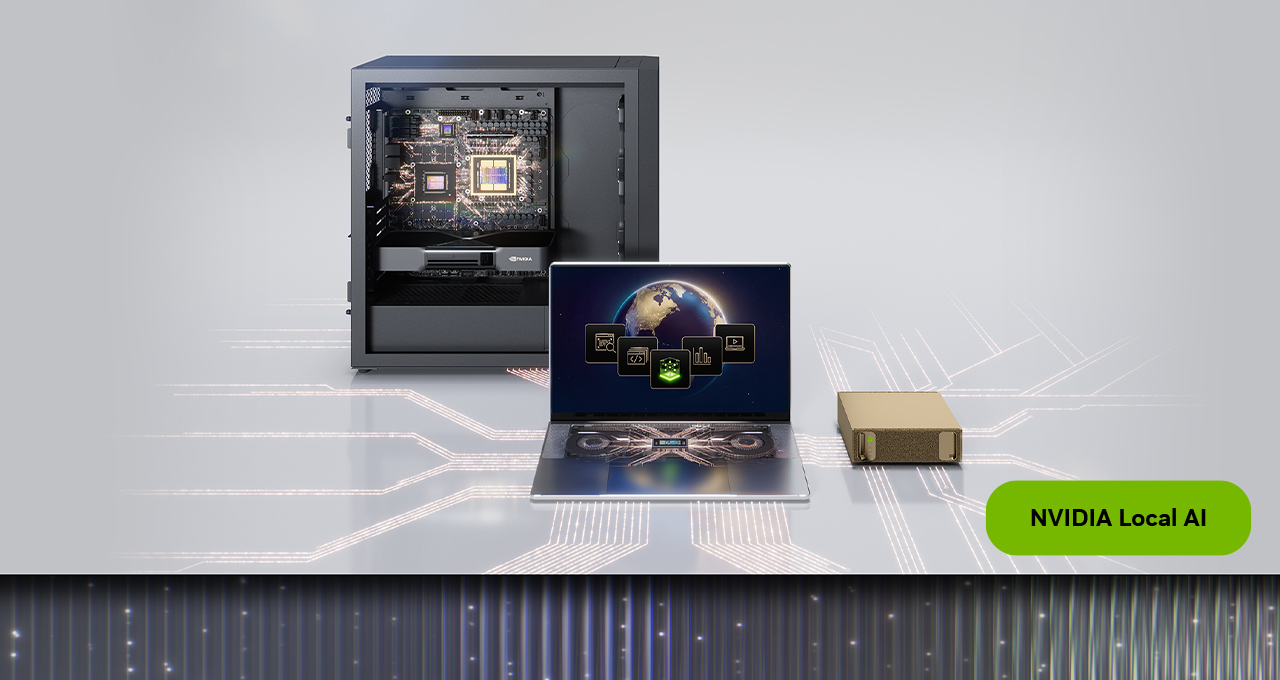
NVIDIA at GTC Berlin pushes local AI lineup: RTX Spark PCs, 8-unit DGX Spark clusters, DGX Station for Windows in December
At GTC Berlin, NVIDIA showcased its local AI hardware lineup and rolled out a wave of companion announcements: RTX Spark PCs (released Oct 16), new DGX Spark 64GB systems shipping Oct 23, eight-unit DGX Spark clustering, DGX Station enterprise support, and day-zero local model releases including Recursive Flint, Nemotron Bolt E4B, and FLUX.3 Klein. The announcements center on running personal agents and frontier-class open models entirely on-device, from consumer laptops to enterprise workstations.
At GTC Berlin, NVIDIA showcased its local AI hardware lineup and rolled out a wave of companion announcements: RTX Spark PCs (released Oct 16), new DGX Spark 64GB systems shipping Oct 23, eight-unit DGX Spark clustering, DGX Station enterprise support, and day-zero local model releases including Recursive Flint, Nemotron Bolt E4B, and FLUX.3 Klein. The announcements center on running personal agents and frontier-class open models entirely on-device, from consumer laptops to enterprise workstations.
0 engagement1 sourcerssWed, Oct 21, 2026, 10:50 AM
Releases·Tool Release
Turing Engine serves 70B models on a single 24GB GPU at 3,064 tok/s
A new inference engine, Turing Engine, claims to serve 70B-parameter models like LLaMA-3.1-70B and Qwen-2.5-72B on a single 24GB GPU, achieving 3,064 tokens per second with 75% KV cache compression. It supports Unsloth checkpoints, potentially enabling high-throughput inference on consumer hardware.
A new inference engine, Turing Engine, claims to serve 70B-parameter models like LLaMA-3.1-70B and Qwen-2.5-72B on a single 24GB GPU, achieving 3,064 tokens per second with 75% KV cache compression. It supports Unsloth checkpoints, potentially enabling high-throughput inference on consumer hardware.
1 engagement1 sourceredditTue, Aug 25, 2026, 10:34 AM
Releases·Tool Release
Unsloth release adds two-GPU image/video generation, floating per-chat browsers, and faster GGUF memory offloading
Unsloth shipped a release bringing large performance fixes across its free, open-source desktop app: faster chat typing/search, faster image and video model loads, and two-GPU image/video generation. It also adds per-chat and floating browsers, unified memory offloading for big models, and a new Dynamic V3.1 Qwen3.8-Flash mode with 50% less token use and 15% higher accuracy. The library side speeds up `model.generate()` for Llama, Qwen2, and Qwen3 on NVIDIA GPUs under Linux.
Unsloth shipped a release bringing large performance fixes across its free, open-source desktop app: faster chat typing/search, faster image and video model loads, and two-GPU image/video generation. It also adds per-chat and floating browsers, unified memory offloading for big models, and a new Dynamic V3.1 Qwen3.8-Flash mode with 50% less token use and 15% higher accuracy. The library side speeds up `model.generate()` for Llama, Qwen2, and Qwen3 on NVIDIA GPUs under Linux.
5 engagement1 sourcegithubFri, Nov 6, 2026, 02:43 PM
Social·Community
Users report running Qwen3.5-397B on 192GB M2 Ultra Mac Pro
A Reddit user with an M2 Ultra Mac Pro (192GB unified memory) reports successfully running the Qwen3.5-397B model using a quantized GGUF (UD-Q3_K_XL) from Unsloth. They also detail contributions to llama.cpp for hybrid recurrent models, including fixing KV cache with vision and enabling slot save/restore with images.
A Reddit user with an M2 Ultra Mac Pro (192GB unified memory) reports successfully running the Qwen3.5-397B model using a quantized GGUF (UD-Q3_K_XL) from Unsloth. They also detail contributions to llama.cpp for hybrid recurrent models, including fixing KV cache with vision and enabling slot save/restore with images.
115 engagement1 sourceredditSun, Jul 19, 2026, 05:29 AM