Releases·Tool Release
Pinecone's Edo Liberty argues agents need a persistent knowledge layer for tribal knowledge
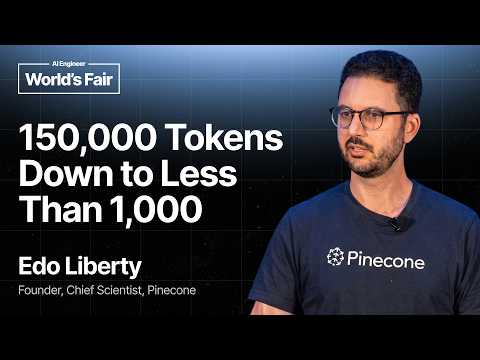
Pinecone CEO Edo Liberty presents Pinecone 2.0, arguing enterprise agents need a persistent, specialized knowledge layer covering not just general and specific knowledge but 'tribal knowledge' — unwritten know-how spread across many documents. The system uses a runtime coding agent that writes and executes code at query time, cutting tooling prompts from ~150,000 tokens to under a thousand. For practitioners, this reframes vector search vendors as agent-memory infrastructure.
34 engagement1 sourceWed, Sep 16, 2026, 01:00 PM
AI Overview
- Liberty splits knowledge into general (trained-in), specific (retrievable contracts/codebases), and tribal knowledge that search cannot reach
- He models enterprise agents as brilliant new hires who start every session on their first day, lacking company context
- Pinecone 2.0 proposes a persistent, specialized knowledge layer all agents query, with staying current as its hardest requirement
- Its runtime coding agent writes and runs code at question time, iterating like a notebook until answers hold
- This approach cut tooling prompts from roughly 150,000 tokens to under a thousand
Related

Social·Community
If we want them to do Knowledge Work, design them as Knowledge Agents — Benjamin Clavié, Mixedbread
In a talk, Mixedbread's Benjamin Clavié argues the industry generalized agent design from coding, the domain least resembling other knowledge work: code carries durable, greppable cues while general knowledge work has implicit meaning and domain-dependent strings. He traces historical tool and organization loops humans used to solve this and cites benchmark numbers showing well-tuned retrieval and searcher-agent layers closing much of the gap to human performance. The practical takeaway for practitioners is to design agents as knowledge agents with better retrieval tooling rather than assuming coding-agent patterns transfer.
In a talk, Mixedbread's Benjamin Clavié argues the industry generalized agent design from coding, the domain least resembling other knowledge work: code carries durable, greppable cues while general knowledge work has implicit meaning and domain-dependent strings. He traces historical tool and organization loops humans used to solve this and cites benchmark numbers showing well-tuned retrieval and searcher-agent layers closing much of the gap to human performance. The practical takeaway for practitioners is to design agents as knowledge agents with better retrieval tooling rather than assuming coding-agent patterns transfer.
140 engagement1 sourceyoutubeWed, Sep 16, 2026, 03:00 PM
Products·launched
Knowl: Agent memory that retires stale facts when they change
Knowl is an agent memory system that not only stores facts but also updates or removes them when they become stale, preventing AI agents from giving conflicting answers. It solves the problem of long-term context management for AI agents, ensuring they always use the latest information. Aimed at developers using AI agents in production.
Knowl is an agent memory system that not only stores facts but also updates or removes them when they become stale, preventing AI agents from giving conflicting answers. It solves the problem of long-term context management for AI agents, ensuring they always use the latest information. Aimed at developers using AI agents in production.
1 engagement1 sourcehackernewsSat, Aug 22, 2026, 02:13 PM

Social·Community
Peter Werry (Unblocked) argues code agents mistake search results for codebase understanding
In a YouTube talk, Unblocked's Peter Werry describes how coding agents fail on real codebases: they search, find one plausible answer, and stop — a failure mode he likens to radiologists' 'satisfaction of search.' He argues access to information is not understanding and frames context engines as the fix, replacing the human role of carrying tribal knowledge.
In a YouTube talk, Unblocked's Peter Werry describes how coding agents fail on real codebases: they search, find one plausible answer, and stop — a failure mode he likens to radiologists' 'satisfaction of search.' He argues access to information is not understanding and frames context engines as the fix, replacing the human role of carrying tribal knowledge.
22 engagement1 sourceyoutubeThu, Aug 27, 2026, 06:00 PM

Social·Community
PromptQL's Tanmai Gopal: scoped-wiki company brains with human-approved writes for Fortune 100 banks
In a YouTube talk, PromptQL's Tanmai Gopal describes plotting daily edits to his company's internal knowledge system (a "company brain"). He expected the typical burst-then-decay usage curve, but edits kept climbing. He reads sustained growth as a sign of trust: as users teach the system new skills like querying, interpreting, and acting on data, each skill adds its own stream of corrections.
In a YouTube talk, PromptQL's Tanmai Gopal describes plotting daily edits to his company's internal knowledge system (a "company brain"). He expected the typical burst-then-decay usage curve, but edits kept climbing. He reads sustained growth as a sign of trust: as users teach the system new skills like querying, interpreting, and acting on data, each skill adds its own stream of corrections.
26 engagement1 sourceyoutubeThu, Sep 3, 2026, 03:30 PM
Developments·Paper
The Agentic Company OS: Substrate Inversion for Sustained Enterprise Agent Deployment
An arXiv position paper argues enterprise AI agents stall in production because they reason over data structured for humans, not for language models. It proposes rebuilding a company's 'cognitive substrate' around agent-matched representations, with schema translation isolated at the action boundary. The paper offers a four-layer framework (Data, Knowledge, Intelligence, Governance) with a Sync Agent and per-skill trust gradient, and outlines a research agenda for evaluating substrates directly.
An arXiv position paper argues enterprise AI agents stall in production because they reason over data structured for humans, not for language models. It proposes rebuilding a company's 'cognitive substrate' around agent-matched representations, with schema translation isolated at the action boundary. The paper offers a four-layer framework (Data, Knowledge, Intelligence, Governance) with a Sync Agent and per-skill trust gradient, and outlines a research agenda for evaluating substrates directly.
0 engagement1 sourcearxivFri, Sep 11, 2026, 09:48 AM