Releases·Hardware Release
NVIDIA Expands Confidential Computing with Confidential Bare Metal for Frontier Model Builders Across Clouds
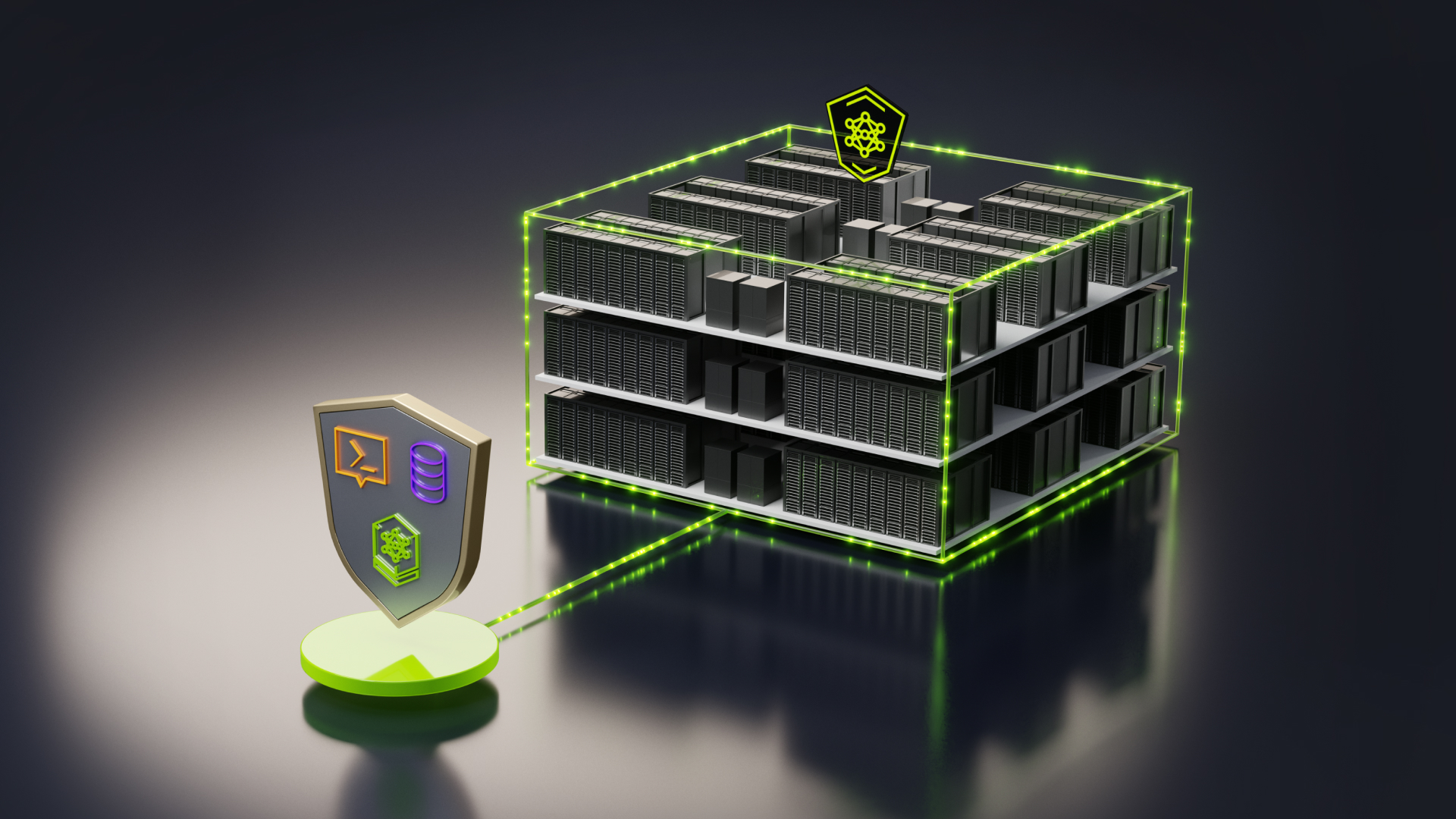
NVIDIA announced Confidential Bare Metal, a new deployment option under NVIDIA Confidential Computing that lets frontier model builders run sensitive workloads on dedicated third-party infrastructure while retaining control of models and data. Google Cloud and Cohere are early adopters, and support now extends to Grace Blackwell NVL72 and Rubin systems.
0 engagement1 sourceWed, Oct 21, 2026, 10:30 AM
AI Overview
- NVIDIA launches Confidential Bare Metal, letting frontier model builders run sensitive workloads on dedicated third-party infrastructure while retaining control of models and data
- Confidential Computing now spans Grace Blackwell NVL72, HGX Rubin NVL8 and DGX Rubin NVL8, and will integrate with NVIDIA DSX OS for AI factories
- Cohere will integrate Confidential Bare Metal into Cohere Model Vault; Google Cloud is extending it to A4X Max instances powered by GB300 NVL72
- CoreWeave, Firmus, GMI Cloud, IREN, Lambda, Microsoft Azure, Nebius, Nscale and Vultr support deployments, with Cisco, Dell, HPE, Lenovo, Supermicro and Bull via NVIDIA-Certified Systems
Entities
Related
Releases·Tool Release
Inside Cohere Model Vault: Building a verifiable confidential AI inference
Cohere announced the public beta of Confidential Computing on Cohere Model Vault, bringing hardware-backed, independently verifiable protection to managed enterprise AI inference. Built with NVIDIA and Microsoft Azure, it protects data in use across confidential CPU and GPU execution and encrypts request payloads end-to-end. The goal is letting enterprises run sensitive workloads on managed AI without the infrastructure operator accessing plaintext data.
Cohere announced the public beta of Confidential Computing on Cohere Model Vault, bringing hardware-backed, independently verifiable protection to managed enterprise AI inference. Built with NVIDIA and Microsoft Azure, it protects data in use across confidential CPU and GPU execution and encrypts request payloads end-to-end. The goal is letting enterprises run sensitive workloads on managed AI without the infrastructure operator accessing plaintext data.
Updated Thu, Oct 22, 2026, 12:00 AM — Cohere published a deep-dive article covering the architecture, encrypted request path, attestation, and threat model
0 engagement2 sourcesrssThu, Oct 22, 2026, 12:00 AM
News·Company News
Enabling Private High-Performance Production AI Inference with NVIDIA Confidential Computing
NVIDIA published a technical post on running production LLM inference inside confidential computing environments, targeting personal, enterprise, and regulated settings where inference handles sensitive data or proprietary model context. The approach uses memory-encrypted confidential virtual machines (CVMs) and confidential GPUs to process workloads in a trusted environment. It gives practitioners a pathway to deploy inference on sensitive data without exposing plaintext memory.
NVIDIA published a technical post on running production LLM inference inside confidential computing environments, targeting personal, enterprise, and regulated settings where inference handles sensitive data or proprietary model context. The approach uses memory-encrypted confidential virtual machines (CVMs) and confidential GPUs to process workloads in a trusted environment. It gives practitioners a pathway to deploy inference on sensitive data without exposing plaintext memory.
0 engagement1 sourcerssTue, Sep 22, 2026, 05:27 PM
Social·Community
Nvidia builds containment system for rogue AI agents
Medium analysis examines Nvidia's cage for rogue AI agents
Medium analysis examines Nvidia's cage for rogue AI agents
0 engagement1 sourcerssFri, Oct 2, 2026, 11:00 PM
Releases·Hardware Release
NVIDIA GB300 NVL72 sets MoE pre-training world record with DeepSeek-V3 671B at 1,648 TFLOPs/GPU
NVIDIA's GB300 NVL72 system achieved a world record for mixture-of-experts pre-training, running DeepSeek-V3 671B at 1,648 TFLOPs per GPU. This demonstrates that communication efficiency, not compute, is now the primary bottleneck for scaling MoE models across thousands of GPUs.
NVIDIA's GB300 NVL72 system achieved a world record for mixture-of-experts pre-training, running DeepSeek-V3 671B at 1,648 TFLOPs per GPU. This demonstrates that communication efficiency, not compute, is now the primary bottleneck for scaling MoE models across thousands of GPUs.
0 engagement1 sourcerssTue, Jul 21, 2026, 06:30 PM

News·Company News
AI Security Is an Engineering Problem — How to Solve It at Every Layer of the Agent Stack
An NVIDIA developer blog argues AI security is an engineering problem requiring defined requirements, enforceable controls, named owners, and evidence controls work. It maps security responsibilities across the agent stack — models, harnesses, runtime environments — and highlights ecosystem tools enforcing boundaries outside the agent's reach. The piece matters to practitioners deploying agents who must restrict access, log actions, and require human approval for consequential actions.
An NVIDIA developer blog argues AI security is an engineering problem requiring defined requirements, enforceable controls, named owners, and evidence controls work. It maps security responsibilities across the agent stack — models, harnesses, runtime environments — and highlights ecosystem tools enforcing boundaries outside the agent's reach. The piece matters to practitioners deploying agents who must restrict access, log actions, and require human approval for consequential actions.
0 engagement1 sourcerssMon, Sep 21, 2026, 02:51 PM