Releases·Tool Release
NVIDIA details scaling MuJoCo robotics simulation to 2,048 parallel GPU environments with Warp and MJWarp
An NVIDIA developer article explains how to migrate a MuJoCo robotics scene — an SO-101 arm doing a pick-and-place task — onto MuJoCo Warp (MJWarp), which runs MuJoCo physics as CUDA kernels on NVIDIA GPUs. It covers the Warp kernel model, batched simulation of up to 2,048 parallel environments, and validation steps for matching CPU and GPU backends. Practitioners gain a concrete recipe for boosting aggregate simulation throughput for reinforcement learning and large-scale sampling.
0 engagement1 sourceWed, Sep 23, 2026, 06:41 PM
AI Overview
- NVIDIA's walkthrough migrates an SO-101 pick-and-place scene from MuJoCo CPU to up to 2,048 parallel MJWarp GPU environments using Warp CUDA kernels.
- MJWarp advances batches via mjw.step, favoring aggregate throughput over single-world latency for RL and large-scale sampling.
- Warp 1.15 adds opt-in GPU-deterministic execution and differentiable kernels; tuning covers CUDA graph capture and nconmax/naconmax/njmax buffer sizing.
Related
Products·building
GPU-accelerated port of the LIBERO robot manipulation benchmark to MuJoCo Warp
A port of the LIBERO robot manipulation benchmark (130 language-conditioned imitation-learning tasks) from CPU robosuite to MuJoCo Warp, runnable on a single ~$700 AMD GPU. LLMs relate via language-conditioned behavioral cloning policies that need fast rollouts for training. It solves slow, single-environment benchmark simulation for robotics/imitation-learning researchers.
A port of the LIBERO robot manipulation benchmark (130 language-conditioned imitation-learning tasks) from CPU robosuite to MuJoCo Warp, runnable on a single ~$700 AMD GPU. LLMs relate via language-conditioned behavioral cloning policies that need fast rollouts for training. It solves slow, single-environment benchmark simulation for robotics/imitation-learning researchers.
1 engagement1 sourceredditWed, Oct 7, 2026, 05:14 PM
Releases·Tool Release
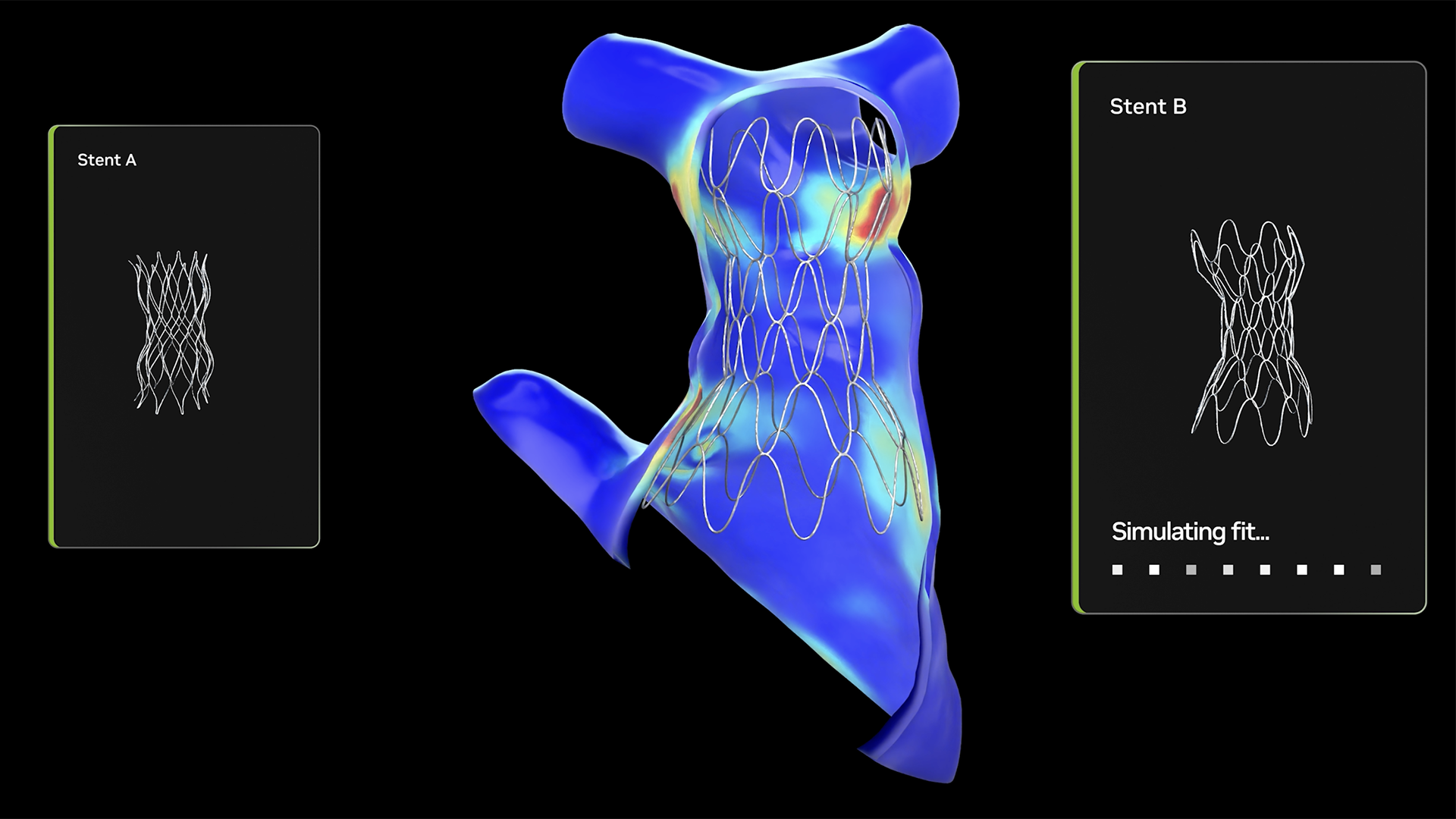
Children's Hospital of Philadelphia Uses Open Source NVIDIA AI to Model Kids' Hearts in Seconds for Cardiac Care
Children's Hospital of Philadelphia builds anatomically precise pediatric heart models in seconds using MONAI Label and NVIDIA Auto3DSeg, cutting a four-hour manual workflow to routine clinical use. CHOP is now integrating NVIDIA's Warp and Newton physics engines to simulate how cardiac devices deploy in a child's anatomy before surgery, aiming for near real-time, same-day clinical decisions. The approach is spreading to 20+ U.S. children's hospitals, with a national consortium forming around shared open source modeling infrastructure.
Children's Hospital of Philadelphia builds anatomically precise pediatric heart models in seconds using MONAI Label and NVIDIA Auto3DSeg, cutting a four-hour manual workflow to routine clinical use. CHOP is now integrating NVIDIA's Warp and Newton physics engines to simulate how cardiac devices deploy in a child's anatomy before surgery, aiming for near real-time, same-day clinical decisions. The approach is spreading to 20+ U.S. children's hospitals, with a national consortium forming around shared open source modeling infrastructure.
0 engagement1 sourcerssTue, Sep 15, 2026, 09:00 AM
Developments·Paper
NVIDIA's AI Learns Why Copying Humans Isn't Enough
A Two Minute Papers video discusses a new NVIDIA paper on human-in-the-loop learning, arguing that simply imitating human actions is insufficient for AI. The video highlights the paper's findings and implications for AI training.
A Two Minute Papers video discusses a new NVIDIA paper on human-in-the-loop learning, arguing that simply imitating human actions is insufficient for AI. The video highlights the paper's findings and implications for AI training.
1.7k engagement1 sourceyoutubeSun, Aug 2, 2026, 03:01 PM
News·Funding
Safeworld exits stealth with $12M seed to safety-test GenAI-powered robots in human simulations
Safeworld, founded by CMU Safe AI Lab director Ding Zhao, Kyle Wong, and Simo Rachidi, launched with over $12 million in seed funding to evaluate generative-AI-driven robotic control systems. The company runs robots in physics simulators against realistic human models to assess safety and build trust for deployment.
Safeworld, founded by CMU Safe AI Lab director Ding Zhao, Kyle Wong, and Simo Rachidi, launched with over $12 million in seed funding to evaluate generative-AI-driven robotic control systems. The company runs robots in physics simulators against realistic human models to assess safety and build trust for deployment.
0 engagement1 sourcerssMon, Oct 5, 2026, 12:00 PM
Developments·Paper
HIERA: Workload-Aware Planning Across Implementation Spaces for GPU Kernel Optimization
Researchers propose HIERA, a hierarchical search-space planning framework that optimizes GPU kernels across multiple implementation spaces. It uses contract-augmented task specifications to balance flexibility and search efficiency, addressing limitations of existing LLM-based methods.
Researchers propose HIERA, a hierarchical search-space planning framework that optimizes GPU kernels across multiple implementation spaces. It uses contract-augmented task specifications to balance flexibility and search efficiency, addressing limitations of existing LLM-based methods.
0 engagement1 sourcearxivFri, Aug 21, 2026, 02:29 PM