Releases·Model Release
NeoHorse-1: Qwen3.5-based 4B and 9B models prototype recursive self-improvement via agentic post-training and routing harness
A technical report on GitHub introduces NeoHorse-1, a family of causal language models positioned as an early prototype toward recursive self-improvement. The 4B and 9B checkpoints are post-trained from Qwen3.5 via agentic post-training with a routing harness.
64 engagement1 sourceFri, Sep 4, 2026, 08:34 AM
AI Overview
- NeoHorse-1 post-trains 4B and 9B Qwen3.5 checkpoints for tool use, coding, and instruction following in agent harnesses.
- A routing harness assigns tasks across a model pool, logs tool outcomes, and feeds capability-level feedback into the next training mixture.
- A technical report covering the harness and post-training landed on arXiv (2609.08183) on 2026-09-09.
- GGUF and quantized NeoHorse-1-4B and 9B models released on Hugging Face under TokenRhythm.
Entities
Related
Developments·Paper
NeoHorse-1: Towards Recursive Self-Improvement via Agentic Post-Training with Routing Harness
Researchers introduce NeoHorse-1, a family of agent-native models aimed at recursive self-improvement via agentic post-training. The system pairs a heterogeneous model pool with intelligent routing, logging predicted capability demand, selected service tier, and subsequent interactions per user turn. It offers a concrete mechanism for converting observed capability evidence into subsequent learning rounds.
Researchers introduce NeoHorse-1, a family of agent-native models aimed at recursive self-improvement via agentic post-training. The system pairs a heterogeneous model pool with intelligent routing, logging predicted capability demand, selected service tier, and subsequent interactions per user turn. It offers a concrete mechanism for converting observed capability evidence into subsequent learning rounds.
0 engagement1 sourcearxivTue, Sep 8, 2026, 03:14 AM

Releases·Tool Release
Prime Agent: An Open-Source Harness for Long-Horizon Coding Agents
Prime Agent is an open-source harness for long-horizon evaluation and coding-agent workflows. It uses a persistent IPython REPL and a Continual Harness to preserve state across trajectories, enabling recursive subagents and self-improvement.
Prime Agent is an open-source harness for long-horizon evaluation and coding-agent workflows. It uses a persistent IPython REPL and a Continual Harness to preserve state across trajectories, enabling recursive subagents and self-improvement.
22 engagement2 sourcesreddit, arxivMon, Aug 24, 2026, 05:54 PM
Developments·Paper
Researchers propose Self-Routing, a behavior-conditioned post-training framework for LLMs
An arXiv paper introduces Self-Routing, a post-training framework that routes each training sample based on the model's own rollout behavior rather than applying one recipe to all samples. Rollout correctness and confidence determine whether a sample goes to GRPO, on-policy self-distillation, regularization, or skipping. The approach requires no external teachers, extra annotations, or additional sampling, and is evaluated on mathematical reasoning.
An arXiv paper introduces Self-Routing, a post-training framework that routes each training sample based on the model's own rollout behavior rather than applying one recipe to all samples. Rollout correctness and confidence determine whether a sample goes to GRPO, on-policy self-distillation, regularization, or skipping. The approach requires no external teachers, extra annotations, or additional sampling, and is evaluated on mathematical reasoning.
0 engagement1 sourcearxivTue, Sep 1, 2026, 03:36 PM
Developments·Paper
Poetiq proposes harness-in-the-loop learning for recursive self-improvement
A startup called Poetiq, founded by former DeepMind researchers, published a paper on harness-in-the-loop learning, where user-constructed harnesses are optimized for both immediate agent performance and the quality of execution traces used to train future models. A separate open-source project demonstrates that a harness trained on a small Qwen 3.6 35B model improves Terminal-Bench scores for four other models.
A startup called Poetiq, founded by former DeepMind researchers, published a paper on harness-in-the-loop learning, where user-constructed harnesses are optimized for both immediate agent performance and the quality of execution traces used to train future models. A separate open-source project demonstrates that a harness trained on a small Qwen 3.6 35B model improves Terminal-Bench scores for four other models.
Updated Mon, Jul 27, 2026, 12:28 PM — A Reddit post shows a harness trained on a small Qwen model improves Terminal-Bench scores for four other models.
1201 engagement3 sourcesarxiv, reddit, rssFri, Jul 17, 2026, 12:21 AM
Social·Community
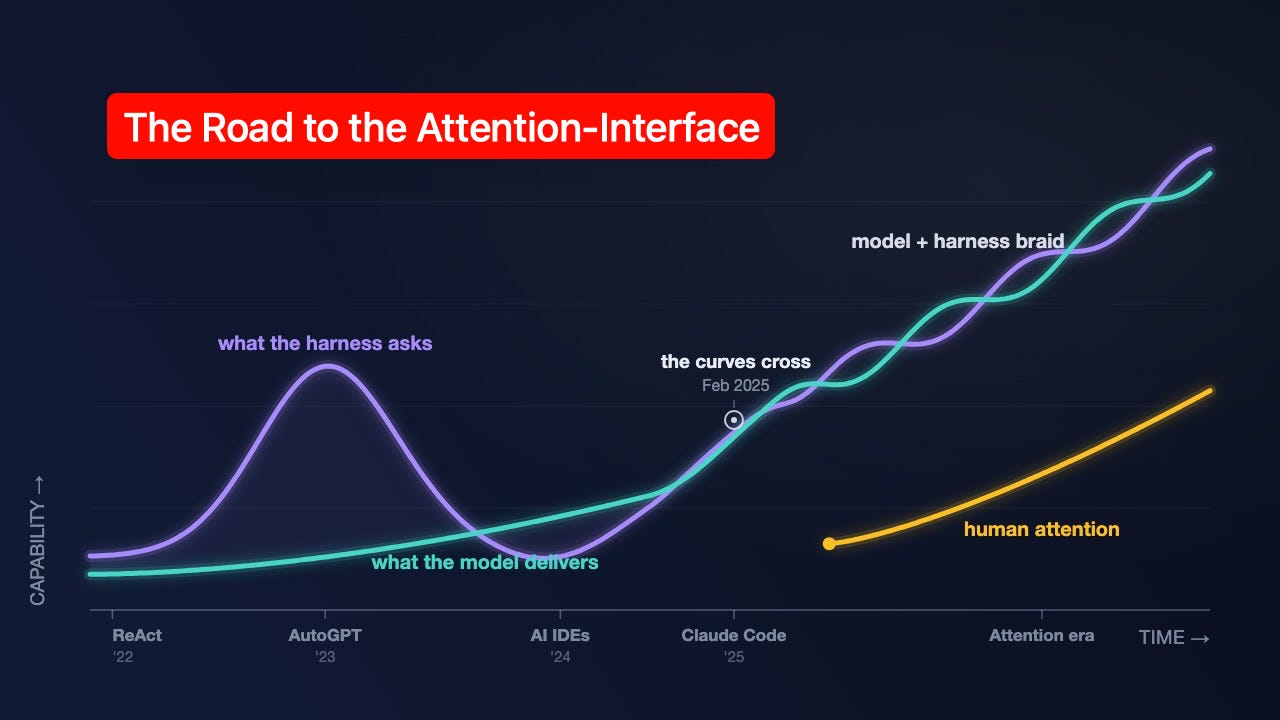
Engineers trace Christmas 2025 agent breakthrough to model-harness convergence
Around Christmas 2025, AI engineers observed that agents began to work reliably, a shift attributed to the combined maturation of models and the wrappers (harnesses) around them. The post argues that the improvement curves of models and harnesses crossed at that moment, and that models will increasingly absorb harness functionality.
Around Christmas 2025, AI engineers observed that agents began to work reliably, a shift attributed to the combined maturation of models and the wrappers (harnesses) around them. The post argues that the improvement curves of models and harnesses crossed at that moment, and that models will increasingly absorb harness functionality.
0 engagement1 sourcerssSat, Aug 22, 2026, 07:30 AM