Releases·Model Releasefeatured
Meta Superintelligence Labs launches Muse Wonder and Wonder Full, Claude 5.5-tier frontier models
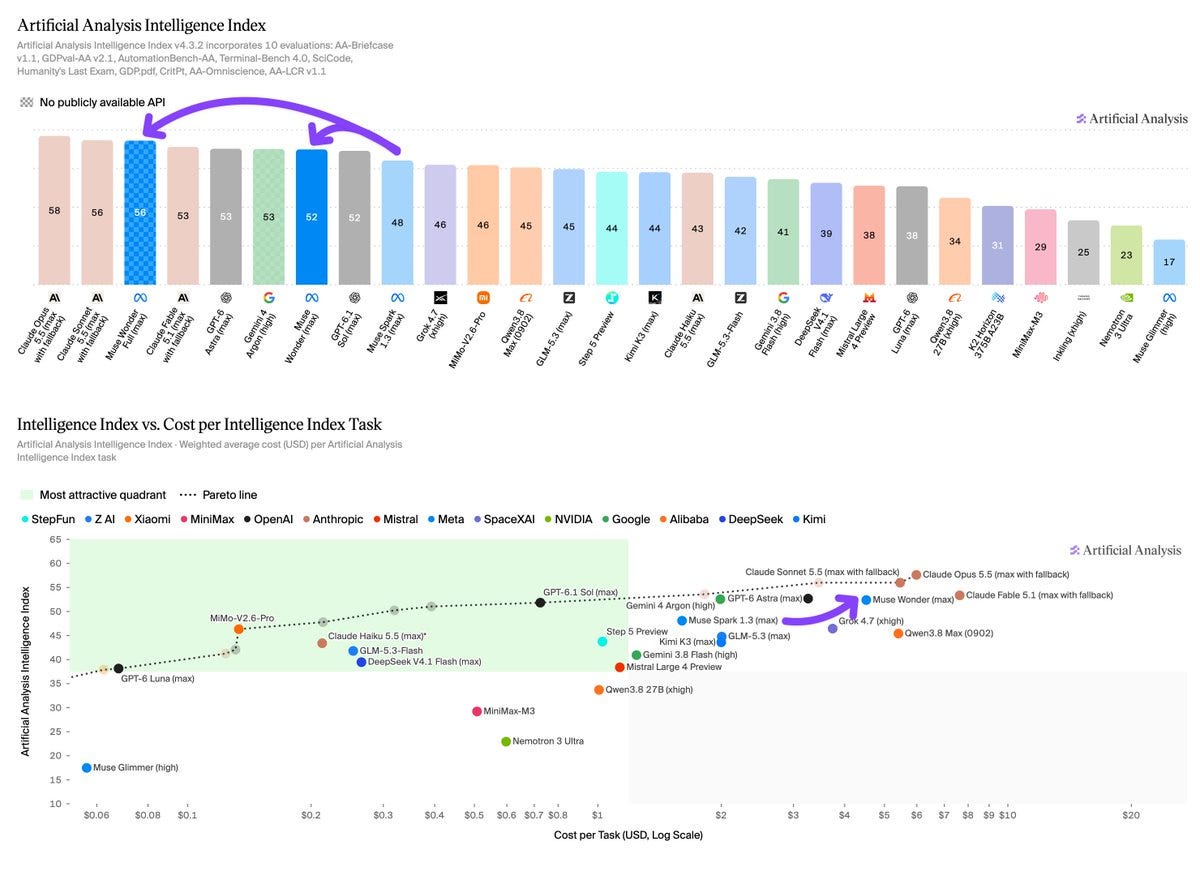
Meta Superintelligence Labs launched Muse Wonder and Muse Wonder Full, its first frontier-class models, ~14 months after the lab was founded under Alexandr Wang. Meta pitches them as state of the art for personal and professional agentic work, with third-party evals placing Wonder Full just behind Claude Opus 5.5 on the Artificial Analysis Intelligence Index. Wonder is available via the Meta Model API at $4/$20 per million tokens; Wonder Full is exclusive to Muse Code subscribers and will power the Muse personal agent.
2562 engagement10 sourcesMon, Oct 12, 2026, 05:02 PM
Developments
Launch-day Muse Code quota-drain bug fixed same day with a quota reset for all users; Artificial Analysis and Vals AI evals published.
Tue, Oct 13, 2026, 09:37 AM
AI Overview
- Meta Superintelligence Labs released Muse Wonder and Muse Wonder Full, its second-generation model family (codename "Watermelon"), roughly 14 months after the lab was founded.
- Meta says Wonder matches Fable 5.1 and GPT-6 Astra on benchmarks; Wonder costs $4.00/$20.00 per million input/output tokens with a 1M context window and $0.20/M cached input.
- Wonder is available via the Meta Model API and Muse Code with six reasoning levels (minimal, low, medium, high, xhigh, max); Wonder Full is exclusive to Muse Code Power/Maximum subscribers, and both models will power the Muse agent.
- Meta highlights the new Active Memory and Active Focus features, which aim to keep the model locked into a stated goal and prevent costly confusion during complex agent tasks.
- It's the first frontier release since Alexandr Wang restructured Meta's AI efforts in August 2025, following lightweight Muse Spark and the Muse agent.
- Wonder Full leads Artificial Analysis' Coding Agents Index at 68, tying Claude Code + Sonnet 5.5; Artificial Analysis scores Muse Wonder (Max) as equivalent to GPT-6.1 Sol, and Meta reports 57.5% SWE-Marathon vs Opus 5.5's 46.3% and GPT-6 Astra's 42.5%.
- Wonder adds Active Memory and Active Focus, features designed to keep agents locked into a stated goal and prevent confusion and compounded errors.
- Meta says Wonder was trained for robustness to adversarial instructions and careful private-data handling; a launch-day quota-draining bug was fixed same day with a full quota reset.
Entities
Related
Releases·Model Release
Meta distills Muse Wonder into specialized models for all Muse and Meta AI users
Meta is rolling out new models trained using its frontier Muse Wonder model to all users of its MUSE personal-agent app and Meta AI, starting November 8. Subscribers retain access to Wonder itself for harder tasks.
Meta is rolling out new models trained using its frontier Muse Wonder model to all users of its MUSE personal-agent app and Meta AI, starting November 8. Subscribers retain access to Wonder itself for harder tasks.
1 engagement1 sourceredditSat, Nov 7, 2026, 12:12 PM
Developments·Benchmark
Meta's new Muse Wonder cost $96 on Pokémon Red and never got past the first forest. Opus 5.5 cost $8.44 and beat Brock.
A community-run Pokémon Red benchmark compared Meta's newly released Muse Wonder against Claude Opus 5.5. Muse Wonder reached Viridian City quickly but then stalled for hundreds of turns in Viridian Forest at a $96.06 total cost, while Opus 5.5 defeated the first gym leader Brock in 271 turns for $8.44. The results, leaderboard, and full run logs were published on pokebench.tv.
A community-run Pokémon Red benchmark compared Meta's newly released Muse Wonder against Claude Opus 5.5. Muse Wonder reached Viridian City quickly but then stalled for hundreds of turns in Viridian Forest at a $96.06 total cost, while Opus 5.5 defeated the first gym leader Brock in 271 turns for $8.44. The results, leaderboard, and full run logs were published on pokebench.tv.
139 engagement1 sourceredditTue, Oct 13, 2026, 05:43 PM
Social·Community
Meta Trained Muse Wonder Not to Give Up. Measuring That Is Harder Than It Looks.
A Medium post discusses Meta's 'Active Focus', its name for agent persistence, and how Meta trained the Muse Wonder model to keep working rather than give up. It argues that measuring persistence is harder than it looks, pointing to benchmarks like FocusBench, SWE-Marathon, and OSWorld.
A Medium post discusses Meta's 'Active Focus', its name for agent persistence, and how Meta trained the Muse Wonder model to keep working rather than give up. It argues that measuring persistence is harder than it looks, pointing to benchmarks like FocusBench, SWE-Marathon, and OSWorld.
0 engagement1 sourcerssSat, Oct 17, 2026, 08:42 PM

Releases·Model Releasefeatured
Meta launches Muse Ember, priced below and outperforming Gemini 3.8 Flash per Artificial Analysis
Meta Superintelligence Lab released Muse Ember on November 9, its smallest and most cost-efficient model, aimed at repetitive agent work: tool calls, coding subtasks, routing, extraction, and long document parsing. It costs $0.10 per million input tokens and $0.50 output, and Artificial Analysis data shows it matching Claude Haiku 5.5 on intelligence while costing roughly a third as much per benchmark task. The release drew criticism from some users who noted Meta continues shipping closed models despite a prior open-source promise.
Meta Superintelligence Lab released Muse Ember on November 9, its smallest and most cost-efficient model, aimed at repetitive agent work: tool calls, coding subtasks, routing, extraction, and long document parsing. It costs $0.10 per million input tokens and $0.50 output, and Artificial Analysis data shows it matching Claude Haiku 5.5 on intelligence while costing roughly a third as much per benchmark task. The release drew criticism from some users who noted Meta continues shipping closed models despite a prior open-source promise.
040658 engagement7 sourcesrss, redditMon, Nov 9, 2026, 12:00 AM
Social·Community
Meta reaffirms Muse Spark will be open weights after Muse Wonder launch
Community members questioned whether Meta had abandoned Muse Spark, but the company confirmed in X posts that the model will be released as open weights. The confirmation came alongside Meta's launch of its new Muse Wonder model.
Community members questioned whether Meta had abandoned Muse Spark, but the company confirmed in X posts that the model will be released as open weights. The confirmation came alongside Meta's launch of its new Muse Wonder model.
17 engagement1 sourceredditTue, Oct 13, 2026, 11:35 PM