Releases·Tool Release
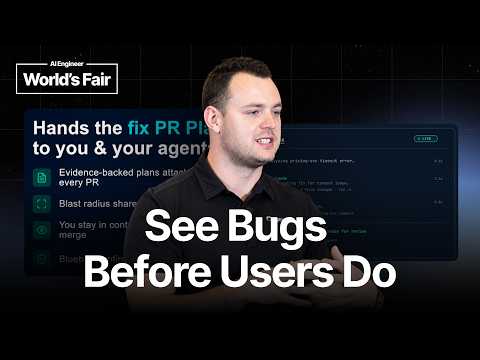
Dynatrace launches Bluebox, an observability agent giving coding agents production context — Matt Gibiec at AI Engineer World's Fair 2026
At AI Engineer World's Fair 2026, Matt Gibiec of Dynatrace argued coding agents fail because they work fast but blind, without context from the environments they change. He introduced Bluebox by Dynatrace, an observability agent for coding agents, demonstrating scenarios like pulling production dependencies into local testing and briefing agents with real usage data before they build. For practitioners, it targets agent loops, cross-service breakage, and hard-to-measure agent value, with humans keeping final control over fixes.
7 engagement1 sourceThu, Oct 8, 2026, 06:30 PM
AI Overview
- Dynatrace AI-native solutions engineering lead Matt Gibiec says coding agents work fast but blind, looping and breaking services without environment context
- Bluebox by Dynatrace brings production dependencies into local testing so laptop changes don't break other services
- Bluebox spots issues before users feel them and ties them to the change that caused them, suggesting fixes accounting for the rest of the system
- Gibiec briefs agents with real usage data before they build, keeping a human in final control of fixes
- Talk recorded at AI Engineer World's Fair 2026 in San Francisco; Bluebox preview at bluebox.ai
Related

Products·building
Vinv: Runtime context for coding agents to find and verify fixes
Vinv (Vibe Inverse) is a tool that runs your services, finds issues, and verifies fixes without code changes. It connects runtime traces to the source code that produced them, giving coding agents runtime information to improve their fixes. It uses Thompson sampling to determine how much runtime context to provide, as more context isn't always better.
Vinv (Vibe Inverse) is a tool that runs your services, finds issues, and verifies fixes without code changes. It connects runtime traces to the source code that produced them, giving coding agents runtime information to improve their fixes. It uses Thompson sampling to determine how much runtime context to provide, as more context isn't always better.
1 engagement1 sourceredditWed, Aug 19, 2026, 06:28 PM
Products·launchedfeatured
HyperProbe: Read-only debugging agents for production
HyperProbe lets coding agents like Cursor and Claude debug production issues by safely dropping virtual breakpoints or probes into running code to extract exact variable values. It saves engineers time by avoiding log digging or redeploying with print statements.
HyperProbe lets coding agents like Cursor and Claude debug production issues by safely dropping virtual breakpoints or probes into running code to extract exact variable values. It saves engineers time by avoiding log digging or redeploying with print statements.
34 engagement1 sourcehackernewsWed, Aug 5, 2026, 04:47 PM
Products·launched
Prefactor: Runtime eval and guardrails for production AI agents
Prefactor is a runtime evaluation and guardrail layer that monitors AI agents in production, detecting drift, tool misuse, and data leakage. It solves the problem of agents that pass test cases but fail in real-world use, giving teams visibility into agent behavior after deployment.
Prefactor is a runtime evaluation and guardrail layer that monitors AI agents in production, detecting drift, tool misuse, and data leakage. It solves the problem of agents that pass test cases but fail in real-world use, giving teams visibility into agent behavior after deployment.
0308 engagement3 sourcesredditWed, Jul 29, 2026, 03:52 AM

Releases·Tool Release
Doug Guthrie's Braintrust workshop walks 968 support traces through AI observability to agent fixes
A YouTube workshop by Doug Guthrie (Braintrust) demonstrates an end-to-end AI observability workflow: tracing a Python support agent built on the OpenAI Agents SDK, grading traces with online automations and custom scorers, clustering failures with Topics, and feeding failures back into evaluation datasets. It culminates in a coding agent using the Braintrust CLI that turns trace findings into reviewed pull requests. The material matters to practitioners building feedback loops between production traces and agent development.
A YouTube workshop by Doug Guthrie (Braintrust) demonstrates an end-to-end AI observability workflow: tracing a Python support agent built on the OpenAI Agents SDK, grading traces with online automations and custom scorers, clustering failures with Topics, and feeding failures back into evaluation datasets. It culminates in a coding agent using the Braintrust CLI that turns trace findings into reviewed pull requests. The material matters to practitioners building feedback loops between production traces and agent development.
0 engagement1 sourceyoutubeTue, Oct 6, 2026, 01:00 AM

Releases·Tool Release
Resolve AI's Varun Krovvidi lays out six pillars of an agentic harness for running production, at AI Engineer World's Fair 2026
At AI Engineer World's Fair 2026, Resolve AI's Varun Krovvidi argues that while AI writes code well, roughly 70% of engineering time goes to running and fixing software — a domain where agents break at scale. He identifies five failure modes and proposes a six-pillar harness, demonstrated with Resolve AI triaging a Grafana alert to root cause.
At AI Engineer World's Fair 2026, Resolve AI's Varun Krovvidi argues that while AI writes code well, roughly 70% of engineering time goes to running and fixing software — a domain where agents break at scale. He identifies five failure modes and proposes a six-pillar harness, demonstrated with Resolve AI triaging a Grafana alert to root cause.
9 engagement1 sourceyoutubeTue, Oct 6, 2026, 11:30 PM