
Releases·Tool Release
Doug Guthrie's Braintrust workshop walks 968 support traces through AI observability to agent fixes
A YouTube workshop by Doug Guthrie (Braintrust) demonstrates an end-to-end AI observability workflow: tracing a Python support agent built on the OpenAI Agents SDK, grading traces with online automations and custom scorers, clustering failures with Topics, and feeding failures back into evaluation datasets. It culminates in a coding agent using the Braintrust CLI that turns trace findings into reviewed pull requests. The material matters to practitioners building feedback loops between production traces and agent development.
0 engagement1 sourceTue, Oct 6, 2026, 01:00 AM
AI Overview
- Guthrie builds a Python support agent on the OpenAI Agents SDK, adds Braintrust tracing, and establishes an offline evaluation baseline with custom scorers
- Online automations grade incoming traces while Braintrust Topics clusters failures by task, sentiment, and workflow; a custom facet catches cases default classification misses
- The Loop assistant queries trace data with SQL, and selected failures return to evaluation datasets as regression examples for later changes
- A coding agent using the Braintrust CLI and an improvement skill proposes code and scorer changes, then packages findings into a pull request for review
- A final demo exposes an agent evaluation to a playground, letting collaborators adjust prompts and models while execution stays on the evaluation server
- Q&A covers deployment, sampling rates, project scope, access controls, and how evaluation assets should evolve with the agent
Related

Social·Community
ClickHouse engineers demo Langfuse monitoring workflow for continuously improving AI support agents
Annabell Schäfer and Lotte Verheyen of ClickHouse present a hands-on Langfuse workshop building a monitoring workflow for a sample IT support agent called Specs. They connect a TypeScript app on the OpenAI Agents SDK to Langfuse, add evaluators for user frustration and out-of-scope requests, then use seeded production traces and a coding agent to surface issues like unnecessary tool calls, retries, and latency. The video frames online monitoring as part of a continuous improvement loop of datasets, offline experiments, and regression checks.
Annabell Schäfer and Lotte Verheyen of ClickHouse present a hands-on Langfuse workshop building a monitoring workflow for a sample IT support agent called Specs. They connect a TypeScript app on the OpenAI Agents SDK to Langfuse, add evaluators for user frustration and out-of-scope requests, then use seeded production traces and a coding agent to surface issues like unnecessary tool calls, retries, and latency. The video frames online monitoring as part of a continuous improvement loop of datasets, offline experiments, and regression checks.
46 engagement1 sourceyoutubeSun, Oct 11, 2026, 06:00 PM

Social·Community
Braintrust's Hossein Niazmandi on why eval platforms beat spreadsheets — AI Engineer World's Fair 2026
At AI Engineer World's Fair 2026, Braintrust's Hossein Niazmandi gave a talk on why measuring agent quality outgrows spreadsheets. He outlined the stages teams move through toward a production eval flywheel and why Braintrust built BTQL for querying large agent traces.
At AI Engineer World's Fair 2026, Braintrust's Hossein Niazmandi gave a talk on why measuring agent quality outgrows spreadsheets. He outlined the stages teams move through toward a production eval flywheel and why Braintrust built BTQL for querying large agent traces.
3 engagement1 sourceyoutubeTue, Oct 6, 2026, 06:30 PM

Social·Community
Warp's Ben Holmes Builds Self-Improving AI Agents That Audit Their Own Transcripts, Score Failures, and Open Fix PRs
In a talk, Ben Holmes of Warp demonstrates a self-improvement loop for coding agents: collect all agent conversations with tool calls and outputs, score them with LLM-as-judge rubrics (redundant tests, verbosity, efficiency), and run a daily agent that opens pull requests fixing skills and config. He also demos Skill Doctor, a skill that can be run on one's own Claude Code or Codex history.
In a talk, Ben Holmes of Warp demonstrates a self-improvement loop for coding agents: collect all agent conversations with tool calls and outputs, score them with LLM-as-judge rubrics (redundant tests, verbosity, efficiency), and run a daily agent that opens pull requests fixing skills and config. He also demos Skill Doctor, a skill that can be run on one's own Claude Code or Codex history.
119 engagement1 sourceyoutubeFri, Nov 6, 2026, 10:00 PM
Social·Community
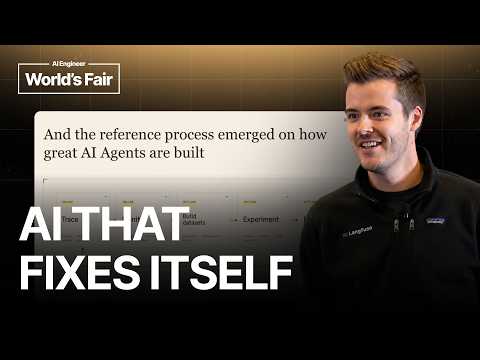
The Self-Improving OSS Agent Stack — Marc Klingen, Langfuse
In a talk recorded at AI Engineer World's Fair 2026, Langfuse co-founder Marc Klingen describes how teams shift from manually reading traces to letting AI run the agent improvement loop. He presents a reference stack linking online tracing and monitoring with offline datasets, experiments, and evals, and demos a coding agent that fixes Langfuse's own changelog writer. Practitioners get a map of which loop layers AI can automate and where humans must stay in charge of direction.
In a talk recorded at AI Engineer World's Fair 2026, Langfuse co-founder Marc Klingen describes how teams shift from manually reading traces to letting AI run the agent improvement loop. He presents a reference stack linking online tracing and monitoring with offline datasets, experiments, and evals, and demos a coding agent that fixes Langfuse's own changelog writer. Practitioners get a map of which loop layers AI can automate and where humans must stay in charge of direction.
47 engagement1 sourceyoutubeTue, Oct 6, 2026, 05:00 PM
Releases·Tool Release
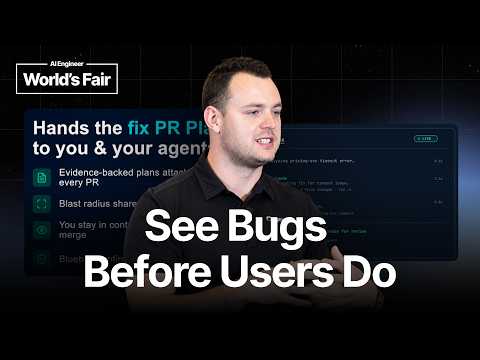
Dynatrace launches Bluebox, an observability agent giving coding agents production context — Matt Gibiec at AI Engineer World's Fair 2026
At AI Engineer World's Fair 2026, Matt Gibiec of Dynatrace argued coding agents fail because they work fast but blind, without context from the environments they change. He introduced Bluebox by Dynatrace, an observability agent for coding agents, demonstrating scenarios like pulling production dependencies into local testing and briefing agents with real usage data before they build. For practitioners, it targets agent loops, cross-service breakage, and hard-to-measure agent value, with humans keeping final control over fixes.
At AI Engineer World's Fair 2026, Matt Gibiec of Dynatrace argued coding agents fail because they work fast but blind, without context from the environments they change. He introduced Bluebox by Dynatrace, an observability agent for coding agents, demonstrating scenarios like pulling production dependencies into local testing and briefing agents with real usage data before they build. For practitioners, it targets agent loops, cross-service breakage, and hard-to-measure agent value, with humans keeping final control over fixes.
7 engagement1 sourceyoutubeThu, Oct 8, 2026, 06:30 PM