Releases·Model Releasefeatured
DeepMind unveils Genie 4 world model promising more realistic physics and humans
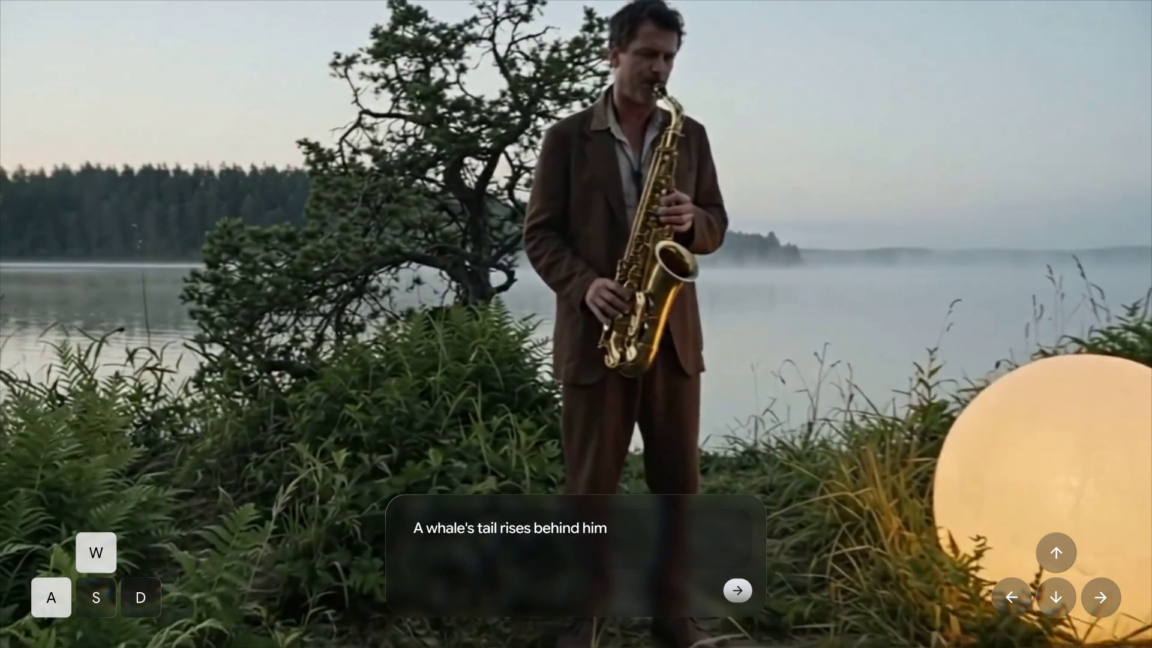
Google DeepMind announced Genie 4, a new world model that generates interactive simulated environments frame by frame in real time, improving on Genie 3 in physics, human realism, live steering, and audio. DeepMind frames world models as a step toward AGI, with uses in robot training environments and creative prototyping. Access appears limited to paying customers.
690 engagement4 sourcesTue, Oct 27, 2026, 04:00 PM
AI Overview
- DeepMind frames world models like Genie 4 as key elements in its march toward artificial general intelligence
- Genie 4 generates interactive virtual worlds frame by frame in real time, with no pre-rendered environments or programmed interactive elements
- DeepMind says Genie 4 could create infinite training environments for physical robots and enable rapid prototyping in creative fields
- Genie 4 improves on Genie 3 in almost every way, aided by Google's updated Gemini models
- DeepMind says paying customers may access Genie 4 soon; Genie 3's 2025 reveal sent gaming stocks tumbling
- Genie 4 adds live steering of simulated worlds and generated audio, per Runtime Wire
Related
Developments·Paper
GS-Agent: Foundation models build 4D worlds from text
Researchers propose GS-Agent, an agentic system that uses foundation models to generate dynamic, physically realistic 4D worlds from natural language descriptions, aiming to reduce manual effort in traditional computer graphics.
Researchers propose GS-Agent, an agentic system that uses foundation models to generate dynamic, physically realistic 4D worlds from natural language descriptions, aiming to reduce manual effort in traditional computer graphics.
0 engagement1 sourcearxivThu, Jul 23, 2026, 05:04 PM

Releases·Model Releasefeatured
World Labs releases Atlas, a spatial world model generating unseen viewpoints and navigable space-time simulations
World Labs announced Atlas, a foundation model for spatial intelligence that ingests text, images, image sequences, camera poses, and depth to build persistent spatial understanding of scenes. Built on an autoregressive diffusion transformer, it generates unseen viewpoints and infers missing geometry rather than only reconstructing observed content, and converts scenes into Gaussian splats for fast rendering. From footage captured on just 3-5 consumer phones it can build complete navigable space-time simulations, positioning it as a step toward physical AI.
World Labs announced Atlas, a foundation model for spatial intelligence that ingests text, images, image sequences, camera poses, and depth to build persistent spatial understanding of scenes. Built on an autoregressive diffusion transformer, it generates unseen viewpoints and infers missing geometry rather than only reconstructing observed content, and converts scenes into Gaussian splats for fast rendering. From footage captured on just 3-5 consumer phones it can build complete navigable space-time simulations, positioning it as a step toward physical AI.
210386 engagement3 sourcesredditTue, Sep 1, 2026, 07:25 PM

Developments·Paper
World models emerge as AI's next frontier beyond LLMs
A new wave of 'world models' is attracting massive funding and research attention, aiming to simulate physical environments and causal reasoning beyond the capabilities of large language models. The post discusses the promise and current limitations of this approach.
A new wave of 'world models' is attracting massive funding and research attention, aiming to simulate physical environments and causal reasoning beyond the capabilities of large language models. The post discusses the promise and current limitations of this approach.
203 engagement2 sourcesrss, redditMon, Jul 13, 2026, 11:00 AM
Social·Community
Community discussion asks what actually counts as a world model
A Reddit discussion asks practitioners to define 'world model,' noting that most current builds are video generation models with roots in cognitive science and reinforcement learning. The thread probes whether simulators, physics engines, and emulators qualify.
A Reddit discussion asks practitioners to define 'world model,' noting that most current builds are video generation models with roots in cognitive science and reinforcement learning. The thread probes whether simulators, physics engines, and emulators qualify.
162 engagement1 sourceredditFri, Aug 28, 2026, 11:37 PM