Releases·Model Release
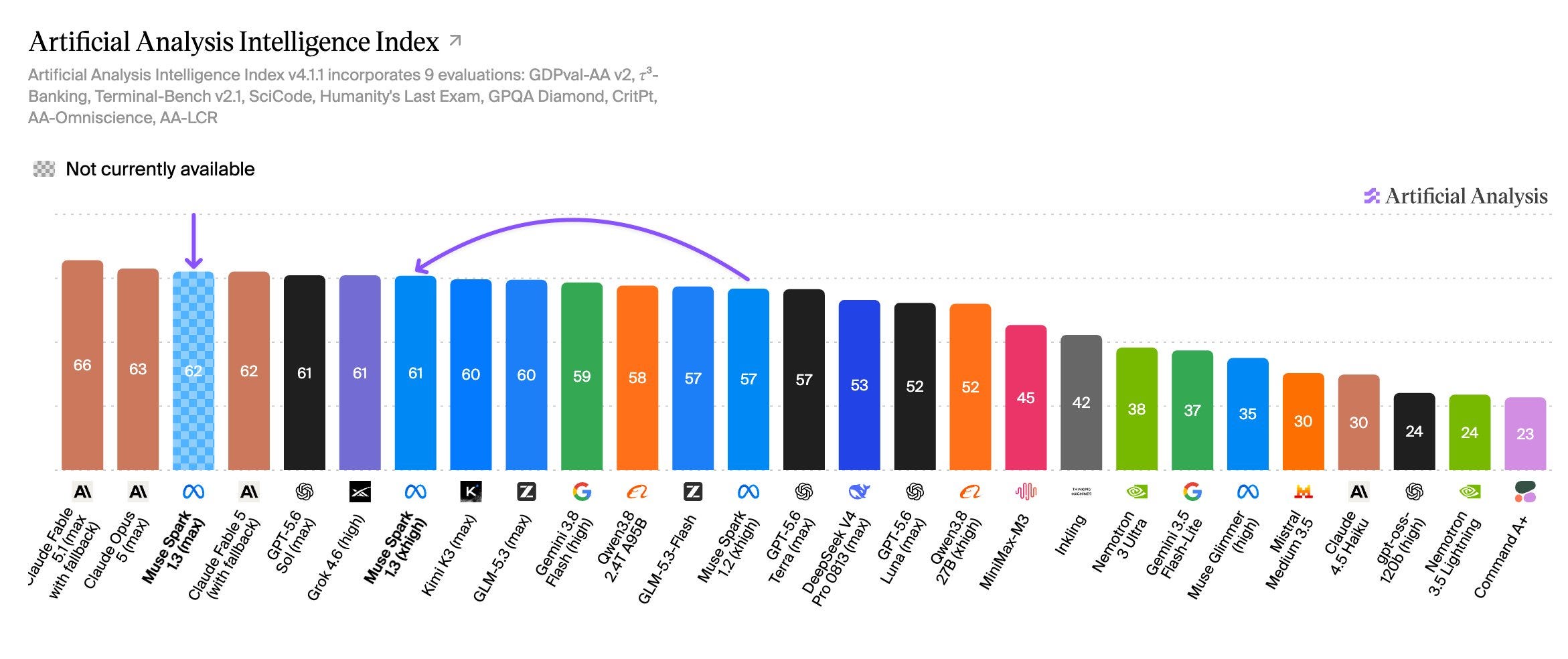
AINews: Muse Spark 1.3 hits #3 on AAII with open-weight pledge, Gemini 3.8 Flash Cyber launches, Stanford formalizes agent engineering
Meta Superintelligence shipped Muse Spark 1.3, the model promised in Mark Zuckerberg's comeback letter the prior month, and the newsletter reports it matches OpenAI's GPT-5.6-Sol — positioning the lab as a new frontier player. The release lands amid a busy launch window that also includes the rumored Gemini 3.8 Flash. The newsletter headline also cites a greater-than-90% discount on training.
0 engagement1 sourceThu, Sep 3, 2026, 04:38 AM
AI Overview
- Meta launched Muse Spark 1.3 for agentic and coding workloads; per Artificial Analysis it is now the #3 model in the world, with open weights promised
- Muse Spark 1.3 uses a pricing model 90%+ cheaper for users who opt in to training
- Gemini 3.8 Flash Cyber scores 86.2% on CyberGym and 47.2% on CWE-Bench patching, with 70%+ on an internal vuln-discovery benchmark across 20 languages
- Stanford's Mihail Eric replaced 85% of Fall 2025 course material with agent engineering topics; Diyi Yang announced CS329Z on building agents from scratch
- ByteDance Seed's HarnessDev paper finds generated harnesses lag human-engineered systems on code/search but match them on writing and ML experimentation across 2,207 instances
- Alibaba's Wan 3.0 ranks #1 in Video Editing with Audio on Artificial Analysis, generating up to 30s at 1080p, priced $0.05-0.20/s in public preview
- Sebastian Raschka argues OpenAI's rumored looped-transformer Astra is a modest tweak, citing Nanbeige 4.2-3B (22 layers reused twice) as precedent
Related
Social·Community
A fast model stops feeling fast when you have to repeat yourself 5 times
A Reddit user reports that Gemini 3.8 Flash's raw generation speed evaporates on multi-instruction tasks, since missed details require repeated corrective messages. The post argues turns-to-result, not generation speed, is the better measure, and asks other 3.8 Flash High users where they draw the line against frontier models.
A Reddit user reports that Gemini 3.8 Flash's raw generation speed evaporates on multi-instruction tasks, since missed details require repeated corrective messages. The post argues turns-to-result, not generation speed, is the better measure, and asks other 3.8 Flash High users where they draw the line against frontier models.
14 engagement1 sourceredditFri, Sep 25, 2026, 12:13 PM
News·Company News
Meta’s Muse just stole the AI spotlight from OpenAI and Anthropic
During a crowded release window in which Anthropic shipped Opus 5.5 and OpenAI followed with GPT-6 updates 90 minutes later, Meta's personal AI agent Muse drew the most attention. A report says Muse is outpacing ChatGPT's early adoption numbers and is headed for Meta's smart glasses. The cluster signals intensifying competition among frontier labs as they time releases against each other.
During a crowded release window in which Anthropic shipped Opus 5.5 and OpenAI followed with GPT-6 updates 90 minutes later, Meta's personal AI agent Muse drew the most attention. A report says Muse is outpacing ChatGPT's early adoption numbers and is headed for Meta's smart glasses. The cluster signals intensifying competition among frontier labs as they time releases against each other.
Updated Sun, Sep 27, 2026, 07:57 PM — Meta's Muse is reportedly outpacing ChatGPT's early adoption numbers and is headed for smart glasses.
0 engagement2 sourcesrssFri, Sep 25, 2026, 06:22 PM
Releases·Model Release
Meta prices Muse Spark 1.1 API at $1.25/$4.25 per million tokens, undercutting OpenAI and Anthropic
Meta's first paid API model, Muse Spark 1.1, is priced at $1.25 per million input tokens and $4.25 per million output tokens, significantly cheaper than OpenAI's GPT-5.5 ($5/$30) and Anthropic's Opus 4.8 ($5/$25). The pricing makes it attractive for applications that don't require frontier-level intelligence, though the comparison is limited to API costs and may not reflect total cost of ownership.
Meta's first paid API model, Muse Spark 1.1, is priced at $1.25 per million input tokens and $4.25 per million output tokens, significantly cheaper than OpenAI's GPT-5.5 ($5/$30) and Anthropic's Opus 4.8 ($5/$25). The pricing makes it attractive for applications that don't require frontier-level intelligence, though the comparison is limited to API costs and may not reflect total cost of ownership.
33 engagement1 sourceredditWed, Jul 15, 2026, 07:54 AM
Releases·Model Release
July 9 saw three labs release models as AI prices drop
On July 9, OpenAI, xAI, and Meta released new models on the same day, a first. OpenAI's tiered Sol, Terra, and Luna family ranges from $1 to $30 per million tokens, letting companies match model to task. Grok 4.5 pushed into coding, and Meta released a system handling one million tokens.
On July 9, OpenAI, xAI, and Meta released new models on the same day, a first. OpenAI's tiered Sol, Terra, and Luna family ranges from $1 to $30 per million tokens, letting companies match model to task. Grok 4.5 pushed into coding, and Meta released a system handling one million tokens.
13 engagement1 sourceredditThu, Jul 9, 2026, 12:00 AM